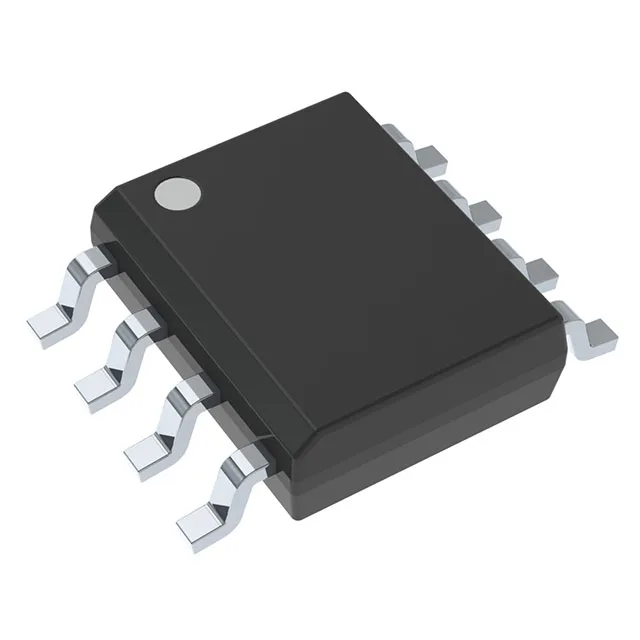
What this dual CMOS op-amp brings to the board
Each of the two channels delivers a 5.5 MHz gain-bandwidth product with a 6 V/µs slew rate while drawing just 750 µA of supply current per amplifier.
6 V/µs slew rate — how fast can it track?
That's fast enough to handle audio signals up to the full bandwidth without visible slew-induced distortion, and it can drive the sampling capacitor of a 12-bit SAR ADC running at a few hundred kHz without settling-time issues. If your design needs to reproduce a 100 kHz square wave with less than 5% rise-time degradation, this part will do it cleanly. The 5.5 MHz gain-bandwidth product supports closed-loop gains up to 10 or 20 while still maintaining a useful small-signal bandwidth of a few hundred kHz.
Supply current and thermal budget
At 750 µA per amplifier, the total quiescent draw for both channels is 1.5 mA. In a 5 V system that's 7.5 mW of dissipation — negligible in a standard SOIC-8 package without airflow. The 50 mA per channel output current capability is enough to drive a headphone load or a low-impedance feedback network, but if you need to source more than a few tens of milliamps continuously, keep an eye on the junction temperature rise.
ROHS3 compliance is confirmed, so it passes the environmental requirements for new designs shipping into Europe or California.