Precision DC amplifier with zero-drift chopping
Its key differentiator is a maximum input offset voltage of 2 µV, achieved through chopper-stabilized auto-zeroing that virtually eliminates 1/f noise and thermal drift. Each channel draws only 17 µA of supply current, making it a strong candidate for battery-powered sensor interfaces, thermocouple amplifiers, and precision current-sense circuits where the power budget is tight.
350 kHz gain-bandwidth — what it buys you
The 350 kHz gain-bandwidth product (GBW) and 0.16 V/µs slew rate place this part firmly in the low-frequency precision camp. It will cleanly amplify a 10 kHz signal with a gain of 35, but don't plan on driving an audio line or a fast SAR ADC input — the bandwidth isn't there. What you get instead is a stable, low-noise front-end for DC-coupled measurements where the signal changes slowly, like a bridge sensor or a photodiode amplifier with a large feedback capacitor.
The output is rail-to-rail, meaning it can swing within millivolts of either supply rail — useful when you need the full ADC input range from a single 3.3 V supply.
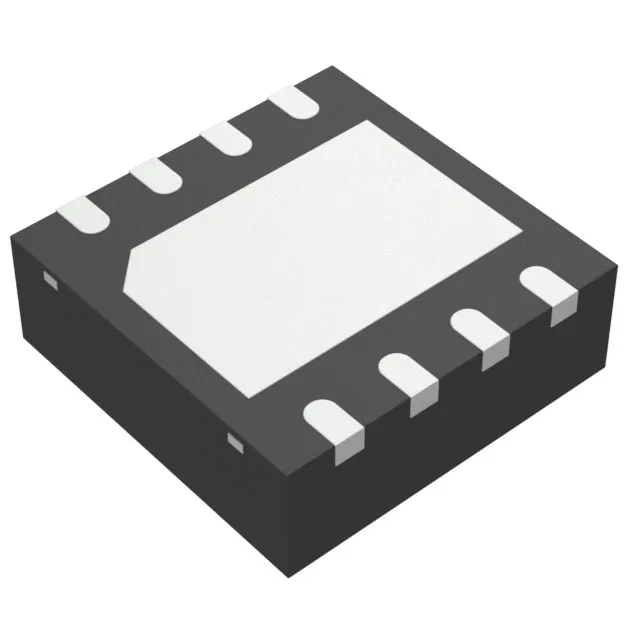
The package is an 8-VDFN with exposed pad, also designated as 8-SON (3x3 mm). The supplier device package code is 8-SON (3x3), so the footprint is consistent across TI's SON family.