What this dual op-amp is built for
Supply current sits at 40 µA per channel, making it a solid micropower choice for battery-operated field instruments or power-sensitive industrial modules.
A 430 kHz gain-bandwidth product means the open-loop gain drops to unity at roughly that frequency. For a closed-loop gain of 10, you get useful bandwidth up to about 43 kHz — enough for audio, process-control signals, and slow ADC drivers. That rules out fast pulse or video applications, but for temperature, pressure, or strain-gauge signals it's more than adequate.
Supply range and current — fit for industrial rails
The OPA2244PA operates from a single supply as low as 2.2 V up to 36 V, or a split supply of ±1.1 V to ±18 V. That spans 3.3 V logic rails, 5 V industrial buses, and 24 V or 36 V system rails common in factory automation and process control.
Through-hole 8-DIP — repair-bench friendly
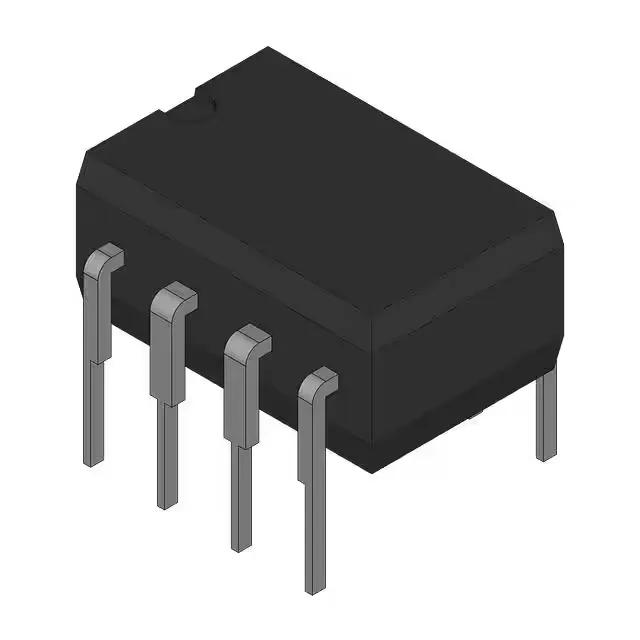
The 8-DIP (0.300" body, 7.62 mm pitch) and 8-PDIP supplier package mean this part is socket-friendly and hand-solderable. For a board-level repair technician, that's a real advantage: you can swap it without hot air or a reflow oven. No exposed thermal pad to worry about; standard 0.1" prototyping grid.
For dual-sourcing resilience, the closest functional alternative in the general-purpose dual op-amp space is the TLV9362IDDFR, but that part is a surface-mount device with a 10.6 MHz GBW and rail-to-rail output — a faster, wider-bandwidth part that may not be a drop-in for designs tuned to the OPA2244PA's 430 kHz bandwidth and through-hole footprint.