It delivers a 10 MHz gain-bandwidth product and a 13 V/µs slew rate, running on supply rails from 10 V to 30 V while drawing 4 mA quiescent current. These ratings place it in the classic audio-frequency signal conditioning tier — fast enough for line-level audio paths, active filters up to several hundred kHz, and precision integrators, but without the rail-to-rail output or sub-microvolt offset of modern precision amps.
The 13 V/µs slew rate sets the large-signal bandwidth: at a 10 V output swing, the full-power bandwidth is roughly 200 kHz. Below that, the 10 MHz gain-bandwidth product governs small-signal gain — a gain-of-10 stage stays flat to 1 MHz. For audio preamp or active crossover designs, this combination keeps distortion low through the audible band. The 500 nA input bias current and 500 µV input offset voltage are typical for a bipolar-input stage; they matter less in AC-coupled paths but need attention in DC-accurate circuits like summing amplifiers or precision references.
Package and mounting — through-hole reality
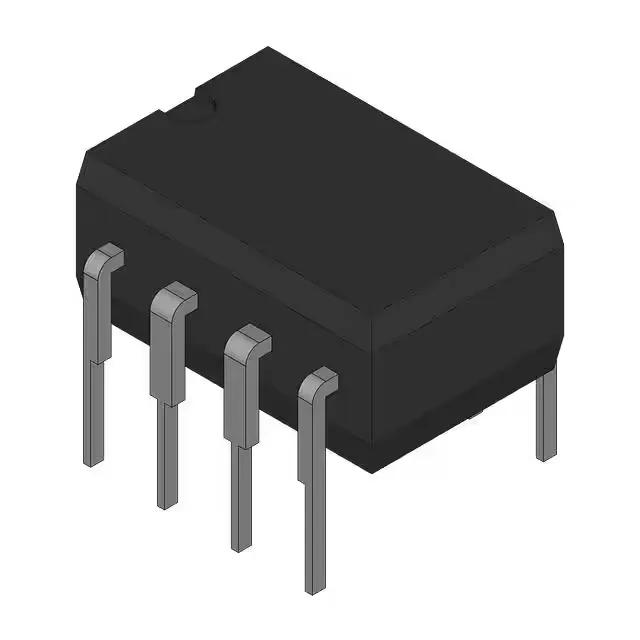
The NE5534P comes in an 8-DIP (0.300" body, 7.62 mm pitch) and ships in tubes. Through-hole mounting means hand-solder or wave-solder only — no reflow profile. The 8-PDIP supplier package footprint is standard, so it drops into existing DIP-8 sockets or PCB layouts without modification. For high-density or automated assembly, consider the surface-mount NE5534D (SOIC-8) variant if the BOM allows a footprint change.
For dual-sourcing resilience, the NE5532 (dual-channel version) shares the same process and performance, though it is a different pinout and circuit count.