It delivers a 10 MHz gain-bandwidth product and a 9V/µs slew rate, drawing 8 mA per channel from a supply span of 10 V to 30 V. The 200 nA input bias current and 500 µV input offset voltage are typical for a bipolar-input op-amp of this generation; the 9V/µs slew rate gives it enough small-signal bandwidth for audio-band processing without the instability risk of a much faster part.
The 9V/µs slew rate sets the maximum output voltage swing rate before slew-induced distortion appears. For a 10 V peak-to-peak output, the full-power bandwidth is roughly 140 kHz — well above the audio band. Below that frequency the 10 MHz gain-bandwidth product governs the closed-loop gain accuracy. A designer choosing between this and a 20 V/µs part is trading slew margin for supply current; the NE5532PSR's 8 mA per channel is moderate for a dual op-amp in this performance tier.
Package and mounting — 8-SOIC footprint
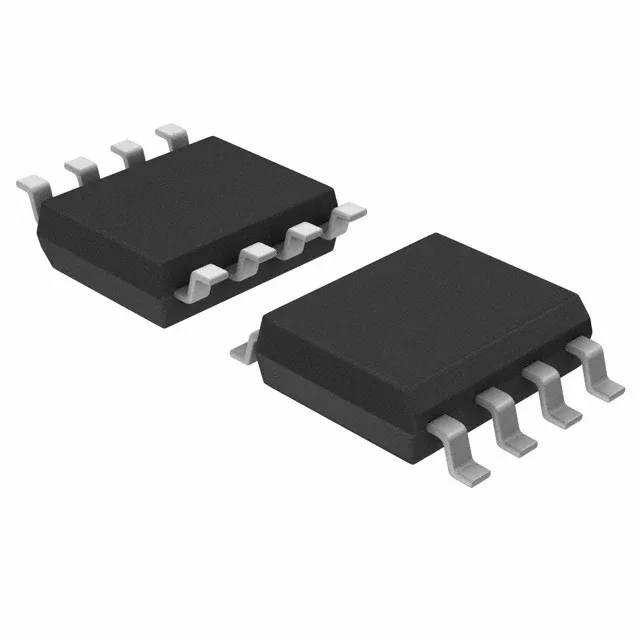
The NE5532PSR is supplied in an 8-SOIC package (5.30 mm body width) and specified for surface-mount assembly. The supplier device package is 8-SO. No exposed pad or thermal slug — the 8 mA per channel dissipation is handled by the standard SOIC copper traces.