16.384 MHz core, three 24-bit sigma-delta ADCs — a measurement MCU, not a general-purpose one
Its headline feature is three independent 24-bit sigma-delta ADCs — the kind of analog front-end you would normally route through an external converter, now integrated on-chip. The core runs at 16.384 MHz, a deliberate clock speed chosen to match power-line cycle rejection (50/60 Hz) without extra filtering. Program memory is 32 KB of Flash, with 2 KB of RAM for data and calibration coefficients.
The three 24-bit sigma-delta converters let this single chip handle simultaneous voltage, current, and temperature sensing in a power meter or a weigh-scale bridge. That integration removes an external ADC and its reference, saving board area and reducing the analog routing headache. The 16.384 MHz clock is not arbitrary — it lets the ADC decimation filter notch out 50 Hz and 60 Hz line noise cleanly, which is why this part shows up in energy-monitoring and industrial sensor designs. If your application does not need that measurement precision, a general-purpose MSP430G series part with fewer ADC bits and a lower price point might be a better fit.
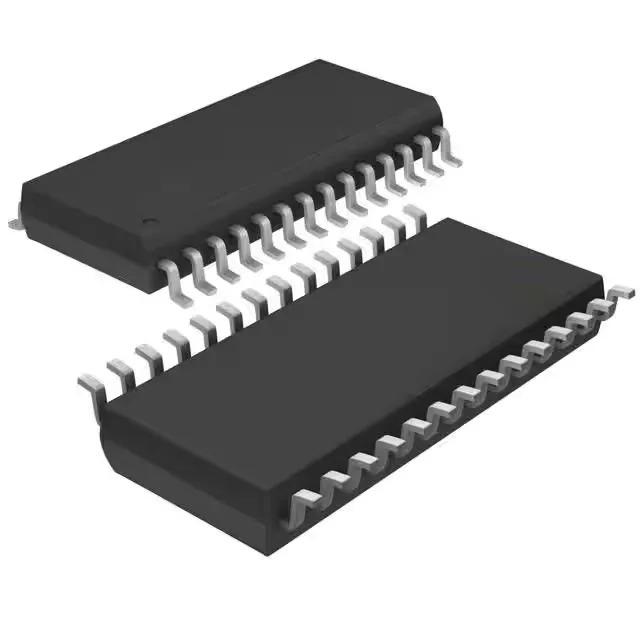
28-TSSOP — footprint and field-swap reality
No hidden thermal pad, no exposed die — just a straightforward SOIC-like body. If you are swapping this on site without a hot-air station, a fine-tip iron and flux wick will get the old one off and the new one aligned. The pin 1 indicator is molded into the package, so orientation is unambiguous even under a magnifying lamp.