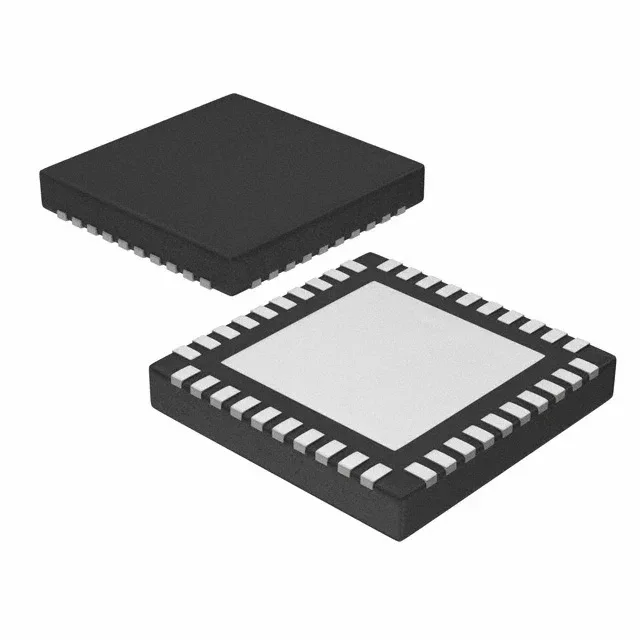
What this MSP430G2755IRHA40R brings to the board
Typical applications include sensor nodes, handheld instruments, motor control, and LIN-bus slave modules where low power and a rich peripheral set are needed.
The 16 MHz clock is the ceiling for this MSP430 core. At that speed the CPU can execute most single-cycle instructions, but you will need to set the Flash wait state to 1 before raising the clock above 8 MHz, or the core will fault on the first branch. The 4 KB RAM handles a few hundred bytes of buffering and a modest call stack; if your application needs larger data arrays, budget for external SPI SRAM or move up the MSP430F5xxx family.
At 3.3 V the internal oscillator is stable within ±1% over temperature after calibration.
Connectivity and analog — what the I/O and ADC cover
With 32 general-purpose I/O pins and a 12-channel 10-bit ADC, this part can handle a dozen analog sensors plus a handful of digital inputs and outputs. The LIN interface is particularly useful for automotive body-electronics slave nodes (window lifts, seat controllers) where the MCU acts as a LIN responder. Note that the ADC is 10-bit, not 12-bit; if you need better than 0.1% resolution on a 3.3 V reference, an external ADC is needed.
Package and mounting — the 40-VQFN footprint
For good thermal performance, stitch vias from the pad to a ground plane on the PCB.
Lifecycle and sourcing — still active, no EOL worry
For dual-sourcing resilience, there is no pin-compatible second source from another vendor, but the MSP430G2xx family includes several Flash-size and RAM variants in the same 40-VQFN footprint that can serve as drop-in upgrades if the firmware fits.