16 KB Flash and 512 B RAM — sizing the firmware and data budget
The 16 MHz clock speed sets the timing budget for PWM generation, UART baud rates, and ADC sampling intervals — at 16 MHz each instruction cycle runs at about 62.5 ns, so interrupt latency and loop timing are predictable for soft real-time tasks.
Supply range and internal oscillator — battery-friendly and crystal-free
The internal oscillator means the MCU can run without an external crystal for basic timing — useful for cost-sensitive or space-constrained boards where a 16 MHz resonator would otherwise take up two I/O pins and board area. For applications needing precise timing (e.g., USB or high-accuracy baud rates), an external clock source can still be fed in.
Industrial temperature grade and on-chip peripherals
The peripheral set includes a brown-out detect and reset (BOR), power-on reset (POR), watchdog timer (WDT), PWM channels, and a DMA controller — enough to handle sensor readout, actuator drive, and low-power sleep/wake cycles without external supervisor ICs.
28-TSSOP package — footprint and assembly notes
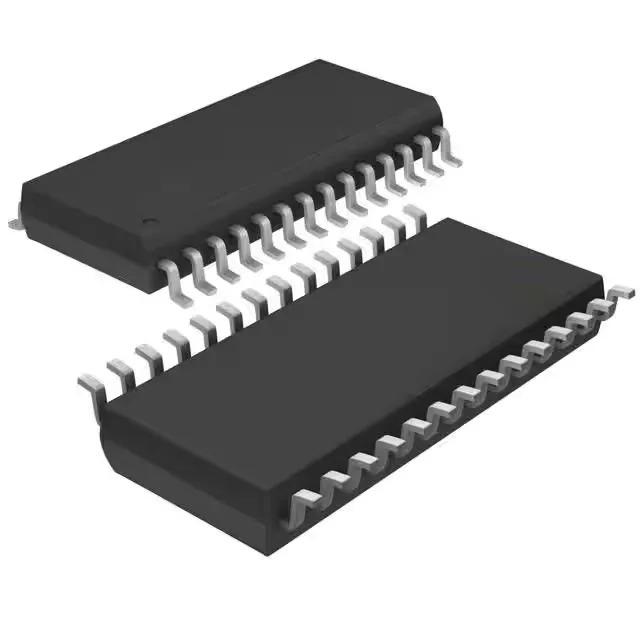
Housed in a 28-TSSOP body (4.40 mm width, 0.65 mm pitch), this surface-mount package suits automated pick-and-place and reflow assembly. The 24 general-purpose I/O pins leave room for a 16x2 character LCD, a row of buttons, or a parallel sensor bus while still keeping the board two-layer routable.
For BOM planning, this MCU is a safe anchor — no last-time-buy scramble expected in the near term.