What the 16 MHz clock and 16 KB flash mean for your firmware budget
The MSP430G2513IN20 runs the MSP430 CPU16 core at 16 MHz — the clock ceiling for this ultra-low-power family. At that speed the core draws roughly 300 µA/MHz in active mode, so the total active current stays under 5 mA even with peripherals enabled. The 16 KB flash (16K x 8) and 512 x 8 RAM set the firmware footprint limit: a typical MSP430 HAL plus a small RTOS or super-loop scheduler leaves about 12 KB for application code, with the remaining 512 B RAM shared between stack and data.
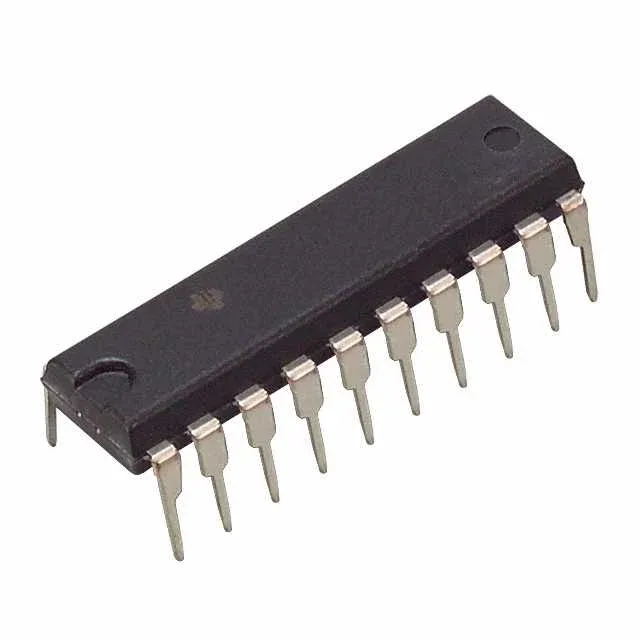
20-pin DIP — breadboard-friendly, but watch the pinout
The 20-DIP (0.300" width, 7.62 mm row spacing) is a through-hole package that fits standard breadboards, prototyping sockets, and legacy production boards. The supplier device package is 20-PDIP — the same mechanical outline. Sixteen general-purpose I/O pins are available; the remaining four are VCC, VSS, RST/NMI, and TEST/VPP. This covers outdoor enclosures, unheated factory floors, and automotive cabin applications (though the part lacks AEC-Q100 qualification).
Active production — no end-of-life watch needed
The base product number is MSP430G2513, and the series is MSP430G2xx — a long-running ultra-low-power family that TI continues to support. ROHS3 compliant per the lifecycle entry. The F280041PZQR is a different architecture (C2000 C28x 32-bit at 100 MHz) in a surface-mount package — it is not a pin-compatible or functional drop-in for the MSP430G2513IN20.
Connectivity and peripherals — what is on-chip
The LINbus support is hardware-assisted, so the bit timing and frame handling do not consume CPU cycles. The SCI and SPI modules share pins with the UART; the pin assignment in the datasheet must be checked against the board schematic to avoid conflicts. On-chip peripherals include a 10-bit ADC (not listed in the spec table but standard for the G2xx3 family), two 16-bit timers with PWM, a watchdog timer, and DMA. The brown-out detect and POR eliminate external reset supervisor ICs for most designs. The internal oscillator is calibrated to ±1% accuracy at 25°C — sufficient for UART communication at 9600 baud without an external crystal.