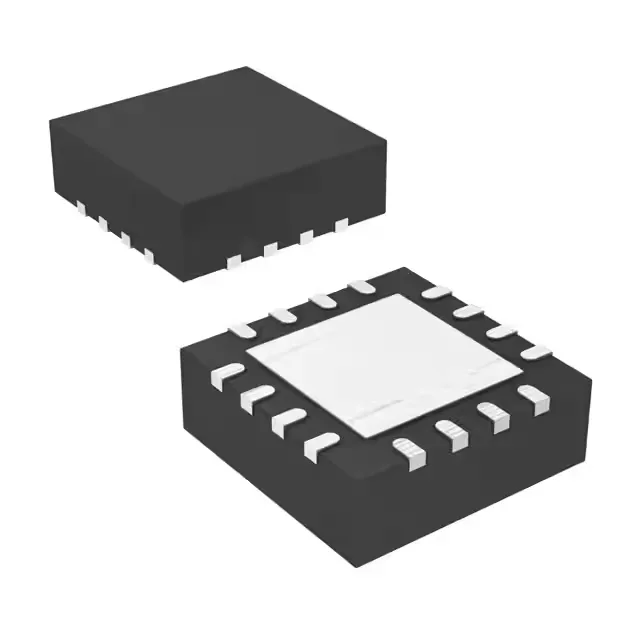
Package and board-fit — 16-QFN exposed pad
The MSP430G2332IRSA16R: Surface-mount only; the exposed pad must connect to ground (or Vss) per the datasheet layout guideline — a floating pad lifts the die temperature above the junction rating under continuous load.
Memory budget and throughput ceiling
4 KB flash (4K x 8) with 256 x 8 bytes of RAM — this is a tight memory envelope suited for a single sensor node reading one ADC channel and reporting over I²C or SPI, not for a multi-threaded protocol stack. The 16 MHz CPU16 core delivers roughly 16 MIPS at full speed, but the flash wait-state profile at 16 MHz introduces one wait state — actual throughput is closer to 8-10 MIPS for sequential code, which still covers most 8-bit replacement applications.
Peripheral set and deployment context
Integrated brown-out detect (BOR) and power-on reset (POR) eliminate the need for an external supervisor — the BOR holds the core in reset if Vcc dips below ~1.35 V, which covers a battery discharge or a glitch on the supply rail. The USI (Universal Serial Interface) can be configured in firmware as either I²C or SPI, but not both simultaneously — allocate the bus at the architecture stage; if both interfaces are needed, a second USI or bit-banged GPIO is required. The 10-bit ADC with 8 multiplexed channels (A/D 8x10b) resolves 1024 code steps over the reference — adequate for a thermistor input, battery voltage divider, or a 4-20 mA loop receiver after scaling. Industrial temperature grade (-40°C to 85°C) qualifies this MCU for outdoor telecom enclosures, HVAC controllers, and factory-floor sensor nodes — not for engine-bay or extended 105°C+ environments.
ROHS3 compliant — no restricted substances above the threshold; no exemption expiry to track for EU or California compliance programs.