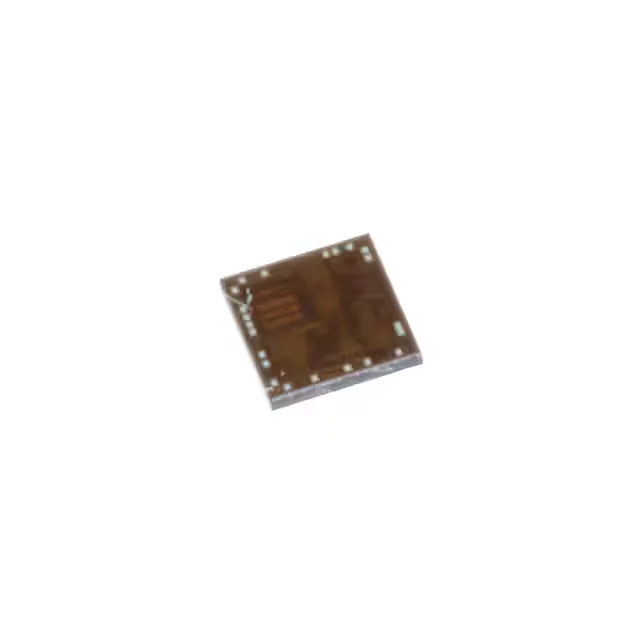
16 MHz MSP430 core in die form — the bare-chip MCU for space-constrained or hybrid assemblies
It is supplied as a bare die (package/case: Die, supplier device package: Die), intended for direct wire-bond or flip-chip integration into multi-chip modules, hybrid circuits, or chip-on-board designs where a packaged QFP or QFN would waste board area or add height. The part includes an internal oscillator, brown-out detect, POR, PWM, WDT, and a 10-bit ADC with 8 multiplexed channels. Connectivity covers I²C, SPI, and USI serial interfaces.
Die procurement — what the bare-chip package means for your assembly line
This is not a packaged part you can drop into a socket or reflow on a standard PCB. The die form factor requires a wafer-level or die-level handling process: pick-and-place with a collet or vacuum ejector, epoxy or eutectic die attach, and wire bonding or flip-chip bumping. The die is surface-mount in the sense that it bonds to a substrate, but there is no molded package, no leads, and no MSL rating in the conventional sense. Your assembly partner needs a clean-room or ESD-controlled environment with die-bonding capability. The 16 I/O and peripheral signals are available at the bond pads — the pad layout is in the TI datasheet (not reproduced here). For prototyping, TI offers the MSP-TS430PZ100 target board, but that board accepts a 100-pin LQFP, not this die; the die is for production-scale MCM or COB integration, not breadboarding.
16 MHz speed and 2 KB Flash — sizing the firmware and timing budget
At 16 MHz the MSP430 CPU16 executes most instructions in one or two clock cycles, delivering roughly 16 MIPS for register-to-register operations. That is enough for 10-bit ADC sampling at several ksps, real-time sensor polling loops, and low-duty-cycle wireless or wired protocol handling (I²C at 400 kHz, SPI at several MHz). The 2 KB Flash limits firmware to small control algorithms, state machines, and calibration tables — expect to fit a bootloader, a sensor driver, and a communication stack in under 1.5 KB if you want room for field updates. The 256-byte RAM (256 x 8) is tight; use the MSP430's register-rich architecture and the DMA peripheral to move data without burdening the stack. For applications needing more memory headroom, the MSP430G2xx family offers higher-density Flash and RAM options in the same die footprint.
The MSP430G2xx series remains a current-production ultra-low-power MCU family from Texas Instruments, with ongoing wafer supply. ROHS3 compliance is confirmed.
The die are sawn from a wafer, tested at the wafer level (known-good-die), and shipped with a date-code spread that reflects the production lot. Because it is a die, there is no molded package marking; traceability is by the lot number on the shipping container. The die form factor means the unit price is generally lower than the packaged equivalent (MSP430G2252IPW or similar), but the handling cost at your assembly house offsets the savings. For production quantities, verify that the die thickness and backside finish match your die-attach process — TI's standard die are typically 8–10 mils thick with a ground backside.