What this 16-bit MCU brings to a low-power BOM
The 10 general-purpose I/O pins, internal oscillator, and integrated peripherals (brown-out detect, POR, PWM, watchdog timer) mean it can handle a basic supervisory or sequencing role without external glue logic.
Memory budget — 2 KB Flash, 128 bytes RAM
The 2 KB Flash (2K x 8) is the entire non-volatile code and constant-data space. That is enough for a bootloader plus a small state machine, but not for a full protocol stack or lookup table. The 128 x 8 SRAM (128 bytes) sets a tight ceiling on stack depth and interrupt nesting — a single deep ISR chain or a moderate-sized local array can overflow it. Any firmware project targeting this part needs a memory map drawn before the first line of C.
Supply and temperature range
Brown-out detection and POR are on-chip, which simplifies the reset circuit and improves reliability in noisy or battery-powered environments.
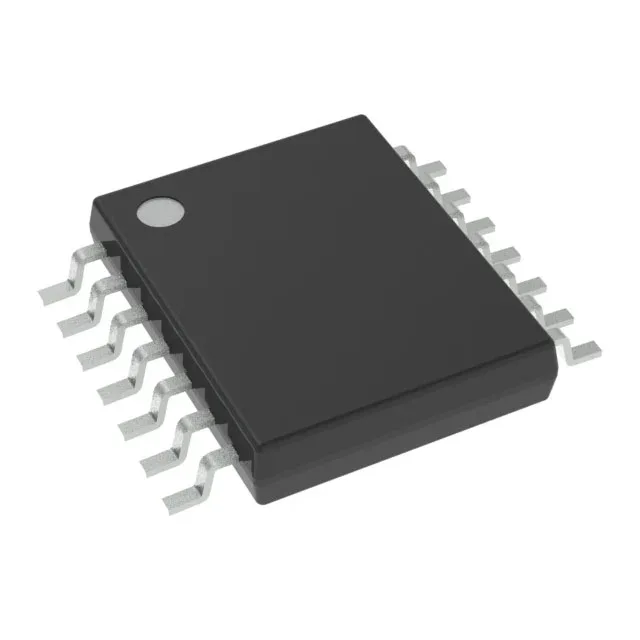
Housed in a 14-TSSOP (4.40 mm body width) with a surface-mount footprint. It is a single-row package with no exposed thermal pad, so all heat dissipates through the leads and the PCB copper. The 14-pin count limits I/O to 10, but that is sufficient for a UART, a couple of ADC inputs (if the part had ADC — this variant does not), or a few GPIOs for LED/switch control.
TI lists the MSP430G2201IPW14R as Active. For a production BOM, this part carries no imminent supply risk.