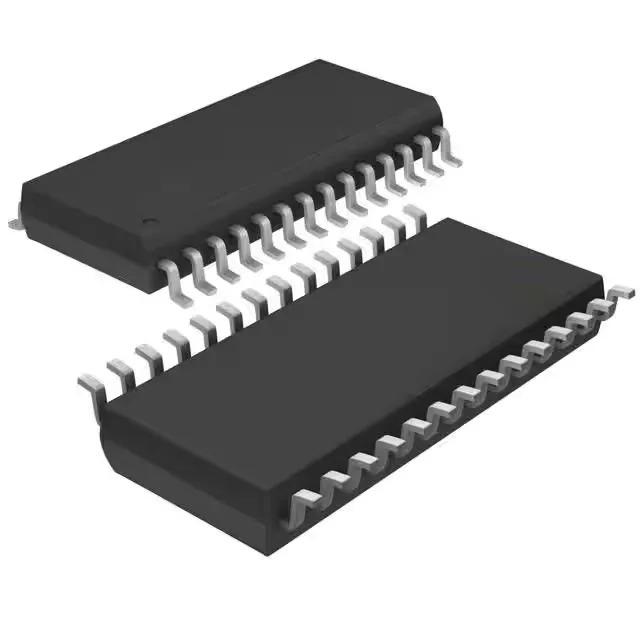
16-bit MCU with 1 KB Flash — fit for sensor and control endpoints
The part integrates a 10-bit ADC with 8 multiplexed channels, a brown-out reset and POR supervisor, a DMA controller, and PWM-capable timer outputs.
1 KB Flash and 256 B RAM — the headroom limit
With 1 KB of Flash and 256 bytes of RAM, this MCU is at the low end of the MSP430G2xx memory options. That constrains firmware to a single-purpose task — a temperature/humidity sensor polling I²C and driving a PWM fan, or a LIN-bus actuator translating a few digital inputs. The 256 x 8 RAM (256 bytes) means no buffering for large data packets; any serial transaction above a few bytes needs careful byte-by-byte handling or an external RAM. For a BOM line, this part fits where the code fits in under 1 KB and the stack and variables stay under 256 bytes — beyond that, step up to the 2 KB or 4 KB Flash siblings in the same G2xx family.
16 MHz clock and on-chip ADC — what the ratings mean
The 16 MHz clock is the CPU and peripheral bus speed. At this frequency the MSP430G2xx draws roughly 230 µA/MHz in active mode, so full-speed operation pulls around 3.7 mA — low enough for battery-powered designs that spend most time in sleep. The 8-channel, 10-bit ADC samples at up to 200 ksps, adequate for slow sensor signals (thermistors, potentiometers, pressure transducers) but not for audio or vibration capture.
RoHS compliance is standard for this series, and no special compliance documentation beyond the standard TI declaration is required for most markets.