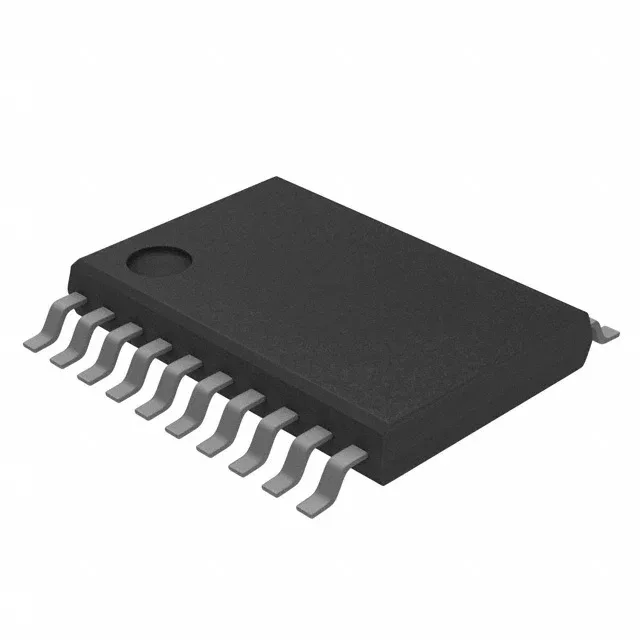
16 MHz MSP430 core with 1 KB flash — the memory ceiling for a single-purpose controller
The MSP430G2153IPW20 is a 16-bit microcontroller from the MSP430G2xx family, clocked at 16 MHz with 1 KB of on-chip flash program memory and 256 bytes of RAM. The flash is the tightest constraint: a firmware image that includes a UART driver, an I²C master, and a 10-bit ADC sampling loop must fit within that 1 KB boundary, leaving no room for a bootloader partition. The 256-byte RAM holds the stack, interrupt context, and data buffers — a single 128-byte UART receive buffer consumes half of it. The 16 MHz clock rate is the CPU's maximum operating frequency; the actual throughput depends on flash wait states and the instruction mix. For a tight control loop that runs from flash with zero wait states at 16 MHz, the core delivers roughly 16 MIPS — enough for a sensor polling loop at a few kilohertz or a LIN slave node responding to bus frames.
The USCI module handles I²C, SPI, and UART in hardware — no software bit-banging needed. The connectivity list also includes IrDA and LIN, which makes this MCU suitable for automotive subnet nodes (LIN slave) or infrared data links in handheld instruments. The 8-channel 10-bit ADC samples at up to 200 ksps; at 10-bit resolution the LSB size is 4.9 mV with a 5 V reference, adequate for reading a thermistor or a potentiometer feedback. The DMA can move ADC results directly to RAM without CPU intervention, leaving the core free for control logic. The brown-out detect resets the MCU if the supply drops below the threshold, preventing flash corruption during a battery swap or a loose connection.
Supply range and temperature grade — battery-friendly and industrial-rated
The wide Vcc tolerance simplifies the power tree in portable or battery-backed designs.
Package and board-fit — 20-TSSOP with 0.65 mm pitch
The device comes in a 20-TSSOP package (4.4 mm body width, 0.65 mm pitch). The supplier device package is 20-TSSOP, and the mounting type is surface mount.
It is ROHS3 compliant. The base product number is MSP430G2153, and the series is MSP430G2xx.