1 KB Flash and 128 bytes RAM — sizing the firmware budget
The MSP430G2152IPW14R is a 16-bit MSP430 CPU16 microcontroller from TI's MSP430G2xx value line, built for ultra-low-power sensing and control tasks. Its 1 KB Flash and 128 bytes RAM are the tightest memory constraints in the G2xx family — this is a part for a single-purpose firmware image, not a multitasking stack. The 16 MHz core speed gives enough throughput for real-time sensor polling and I²C/SPI communication via the USI peripheral, but the RAM ceiling means every byte of stack and variable space must be accounted for at compile time. The 8-channel 10-bit ADC (A/D 8x10b) lets it digitise analog inputs directly, saving an external converter on a simple sensor node.
The internal oscillator (Oscillator Type: Internal) eliminates the external crystal for many designs, saving two pins and a few cents on the BOM — though the internal RC accuracy is adequate for UART baud-rate generation and general-purpose timing, not precision real-time clocks.
Peripherals and I/O — what fits in 10 pins
With 10 I/O pins and connectivity limited to I²C, SPI, and USI (the universal serial interface that can emulate either), the pinout forces trade-offs: you get one serial bus plus a handful of GPIOs for buttons, LEDs, or chip selects. The Brown-out Detect/Reset, POR, and WDT peripherals are standard for reliable single-chip operation; the DMA block can move ADC results to RAM without CPU intervention, which helps stretch the 128-byte RAM budget by reducing interrupt overhead.
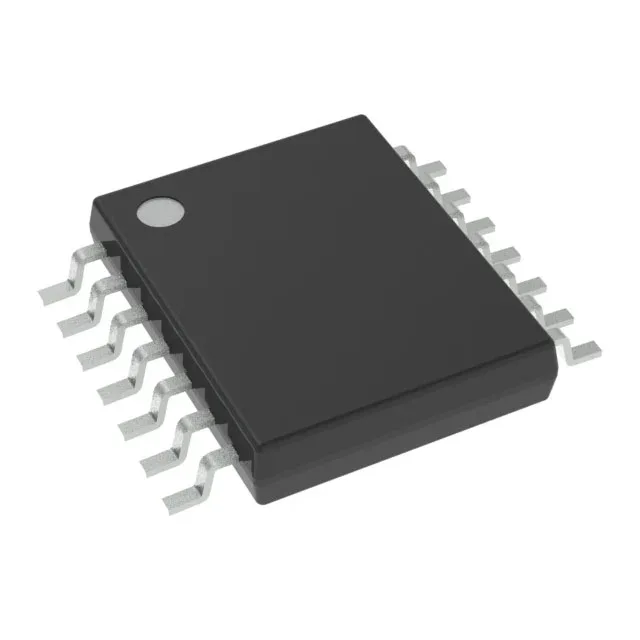
Package and footprint — 14-TSSOP
The 14-TSSOP (0.173", 4.40 mm width) is a fine-pitch surface-mount package that fits tight PCB layouts. No exposed thermal pad — all heat dissipates through the leads, so keep the ambient load light in high-temperature environments.