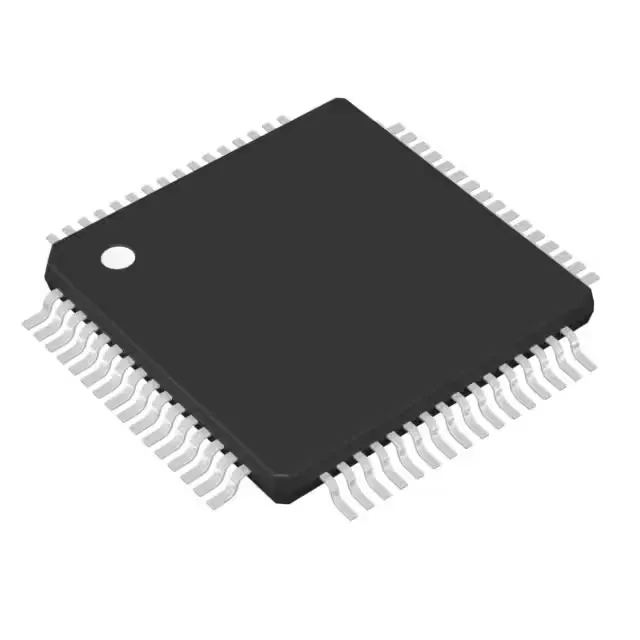
The part is notable for its on-chip LCD driver and Slope A/D converter, which together reduce external component count in utility-metering, flow-sensing, and battery-powered display applications.
1 KB RAM — the tight-resource reality
With 1 KB of RAM, this MCU is not a general-purpose workhorse. The memory budget forces careful stack management and limits buffer sizes for display frames or communication packets. It is sized for applications where the firmware is lean — reading a sensor, driving an LCD segment, and waking briefly to transmit a reading. Designs that need larger data buffers or complex protocol stacks should look at higher-RAM siblings in the MSP430x4xx family.
LCD driver and Slope A/D — what they save on the BOM
The Slope A/D converter provides a ratiometric conversion path for resistive sensors (e.g., thermistors, pressure transducers) without an external ADC. For flow-meter and energy-meter designs, these two peripherals are the main reason to pick this part over a simpler MSP430G2xx — they cut the component count and board area noticeably.
Supply range and power strategy
The internal oscillator (8 MHz) is available without an external crystal, though the MSP430x4xx also supports a low-frequency watch crystal for RTC accuracy. The brown-out reset and POR peripherals are on-chip, so the design only needs a clean supply rail and decoupling caps to start reliably.
The base product number MSP430FW427 covers multiple package and tape options, so the IPMR (64-LQFP, tape-and-reel) variant is a standard ordering code.