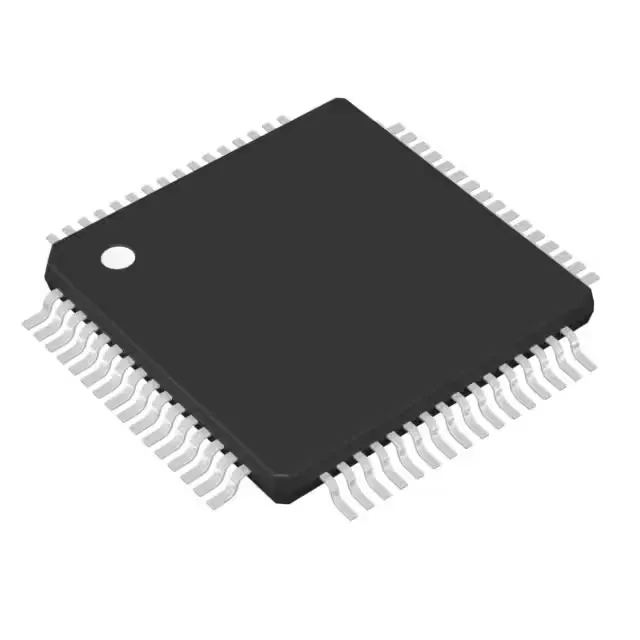
FRAM-based 16-bit MCU with integrated LCD drive
Its program memory is 32 KB of FRAM—a non-volatile memory that combines the write speed and endurance of SRAM with the retention of Flash, eliminating the erase-before-write penalty typical of Flash-based MCUs. The device also includes 2K x 8 of RAM and a rich set of peripherals: a segment LCD controller, DMA, brown-out detect, POR, PWM, WDT, and multiple serial interfaces (I²C, IrDA, SCI, SPI, UART/USART). With 51 general-purpose I/O lines and an internal oscillator, it is designed for low-power, mixed-signal applications such as smart meters, building automation, portable medical devices, and industrial sensor nodes that need a local display.
FRAM advantage: no erase cycles, unified memory
The 32 KB FRAM program store is the standout feature. Unlike Flash, FRAM writes at bus speed without a separate erase step, and endurance is orders of magnitude higher—typically 10^15 write cycles versus 10^4–10^5 for Flash. This matters for data-logging applications that accumulate frequent small writes, or for over-the-air firmware updates where the update agent can write directly to the program area without a RAM buffer. The 2K x 8 RAM supplements the FRAM for stack and volatile variables.
Package and footprint: 64-LQFP
The 51 I/O lines are mapped to the peripheral set, including the LCD segment drive signals, so board layout must account for the display routing. No exposed thermal pad—dissipation is through the package leads and board copper.
For new designs, this means no near-term last-time-buy risk. The base product number is MSP430FR6970, and the device is RoHS compliant per TI's standard lead-free finish.