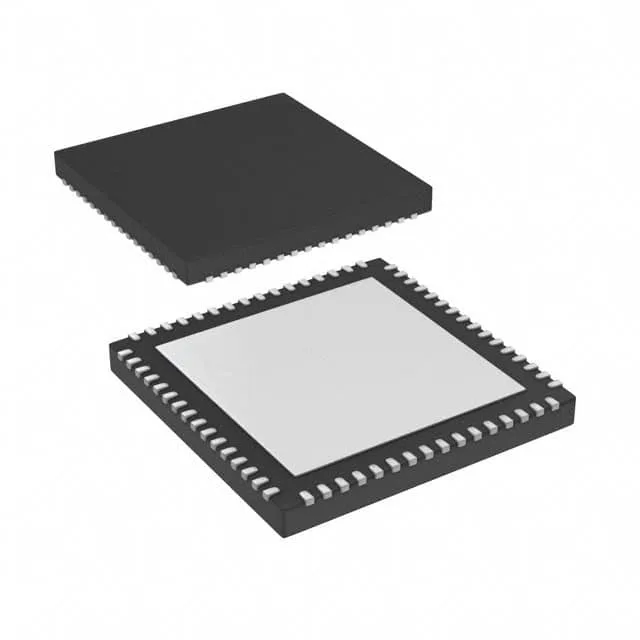
FRAM-based 16-bit MCU with integrated LCD driver
The part integrates a segment LCD driver, 52 general-purpose I/O lines, an 8-channel 12-bit ADC, and serial interfaces including I²C, SPI, and UART.
64-VQFN package — rework and layout notes
Housed in a 64-VFQFN with exposed pad (supplier package 64-VQFN 9x9 mm), this part wants a solid thermal via stitch under the paddle to pull heat into the board plane. Orientation is marked by a chamfered corner and a pin-1 dot; the pad array is 0.5 mm pitch, so a good stencil and reflow profile matter. Under the hot-air station, preheat the board to 125°C before lifting the part to avoid lifting the pads.
The 64 KB FRAM program memory writes at full speed with no erase cycle, so you can update firmware fields in situ without wearing out the memory. Contrast that with a typical Flash MCU where a sector erase takes milliseconds and endurance is 10k cycles — FRAM endurance is orders of magnitude higher, making it a fit for data-logging or over-the-air update scenarios where the code space is rewritten frequently. The 2K x 8 RAM is modest, but FRAM can serve double duty for variables that need non-volatility.
That means no last-time-buy pressure and no forced redesign for the foreseeable future. For dual-sourcing, the pin-compatible part with a different tape/reel suffix shares the same die and footprint, verified by TI's base product number.