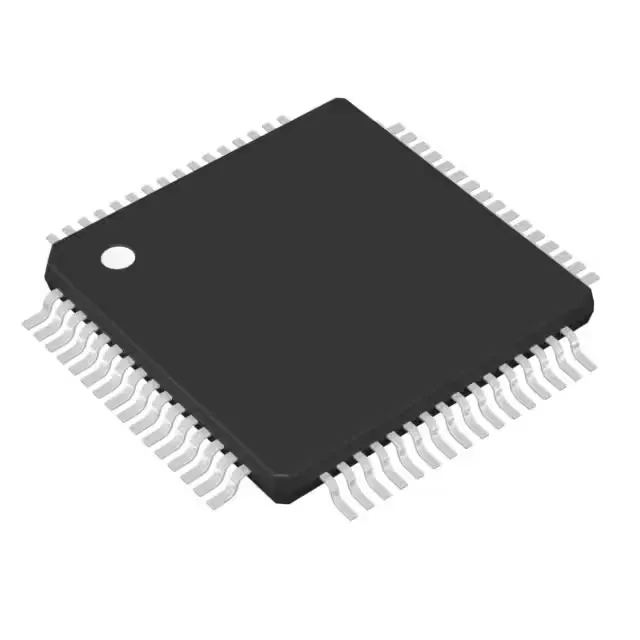
FRAM MCU for low-power metering and display control
FRAM replaces conventional Flash — it writes at near-SRAM speed, consumes less active power per write, and eliminates the erase-before-write penalty, making it a strong fit for data-logging, metering, and applications that update nonvolatile storage frequently. The device integrates an LCD driver, an 8-channel 12-bit ADC, and serial interfaces including I²C, SPI, and UART, all in a 64-LQFP package with 52 available I/O.
64 KB FRAM — no erase cycles, faster writes
The 64 KB FRAM (ferroelectric RAM) program memory is the headline feature here. Unlike Flash, FRAM writes at bus speed, consumes about 100x less energy per byte written, and endures over 10^15 write cycles — effectively unlimited for field updates. This matters for designs that log sensor data, store calibration constants, or run OTA firmware updates: you skip the erase-sector step and the wear-leveling overhead. The 2K x 8 SRAM is modest, sized for small buffers and stack operations typical of the MSP430 architecture.
The internal oscillator reduces external BOM count, though an external crystal can be used for tighter timing.
Package and peripheral set for mixed-signal control
The 64-LQFP (10x10 mm) package is a low-profile QFP with 0.5 mm pitch, hand-solderable and inspectable, no underfill required. The 52 I/O provide ample headroom for segment-LCD glass, keypad matrix, and sensor interrupts alongside the serial buses. The 8-channel 12-bit ADC samples at up to 200 ksps — adequate for current-sense resistors, thermistor inputs, or battery voltage monitoring. Brown-out detect and POR are integrated, reducing external supervisor ICs.