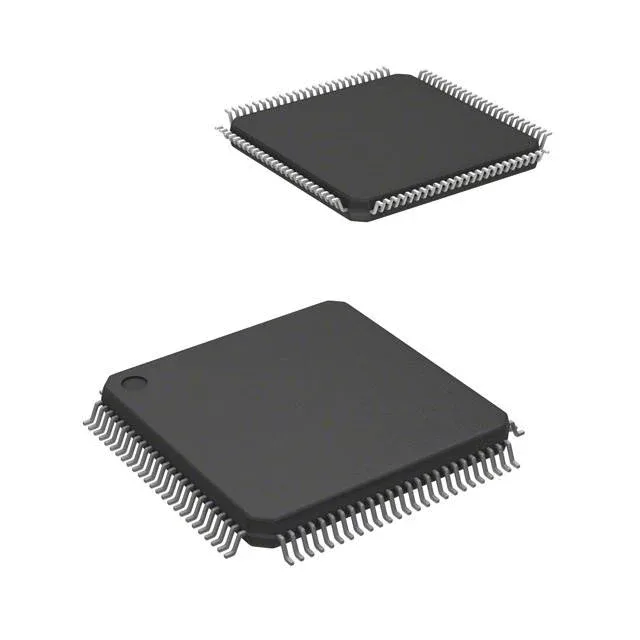
128 KB FRAM — no flash wear, no write-cycle budget
Its 128 KB program memory is FRAM, not flash — endurance is effectively unlimited (10^15 write cycles), so you can log data, update firmware over the air, or store calibration constants without wear-leveling or sector-erase delays. The 2 KB of conventional RAM handles stack and small buffers; for larger data structures the FRAM is directly addressable as unified memory.
16 MHz — fast enough for sensor fusion, not for video
16 MHz is the sweet spot for this ultra-low-power family. It handles 12-bit ADC conversions at 200 ksps, I²C/SPI/UART communication, and real-time control loops (PID, sensor fusion) without burning through the power budget.
Industrial temp range and 83 I/O — fits factory-floor panels
With 83 general-purpose I/O pins in a 100-LQFP (14x14 mm), you have enough headroom for parallel LCD interfaces, keypad matrices, and multiple external peripherals — no need for port expanders in most designs. The brown-out reset and POR supervisor keep the MCU from corrupting FRAM during supply dips down to 1.8 V.
Active lifecycle — no end-of-life clock ticking
TI lists the MSP430FR6889IPZ as Active. The base product number MSP430FR6889 covers the whole density and package family, so new designs can rely on continued supply. No LTB window, no last-call scramble — just a standard production part you can qualify into a BOM today.