32KB FRAM — no wear-leveling, no erase penalty
That matters for metering, logging, or any application where the firmware updates a nonvolatile field mid-cycle. The 57 general-purpose I/O lines and integrated peripherals — brown-out detect, DMA, LCD driver, POR, PWM, watchdog timer — cover most sensor-interface and display tasks without external glue logic. Connectivity includes I²C, IrDA, and SPI, which is the usual set for talking to external ADCs, RF modules, or serial EEPROMs.
1.8V to 3.6V supply — single-cell battery ready
If you need precision timing for the real-time clock, the internal oscillator is adequate for many metering and logging intervals, though an external watch crystal can still be added via the I/O pins.
Industrial temperature grade, active lifecycle
TI continues to manufacture the MSP430FR6041IPN, so you can design it in without worrying about a forced migration mid-production.
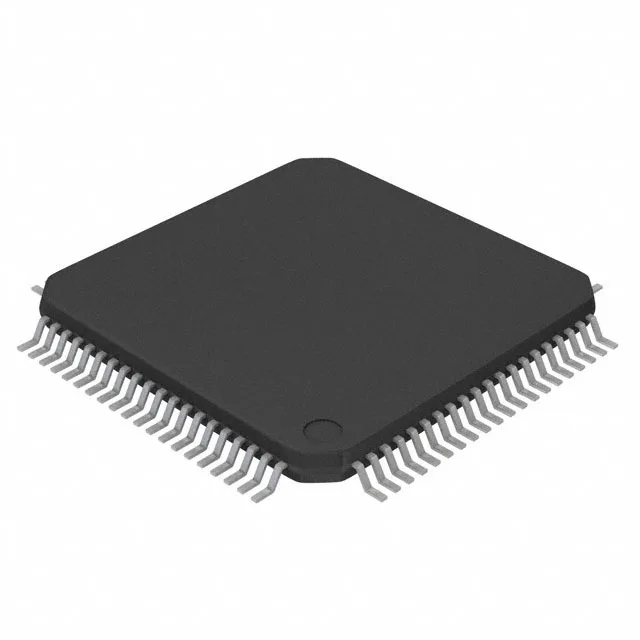
80-LQFP (12x12mm) — standard footprint
The 80-lead LQFP package measures 12x12mm with a 0.5mm pitch. This is a common land pattern shared across many MSP430 and other MCU families, so the PCB layout is straightforward.