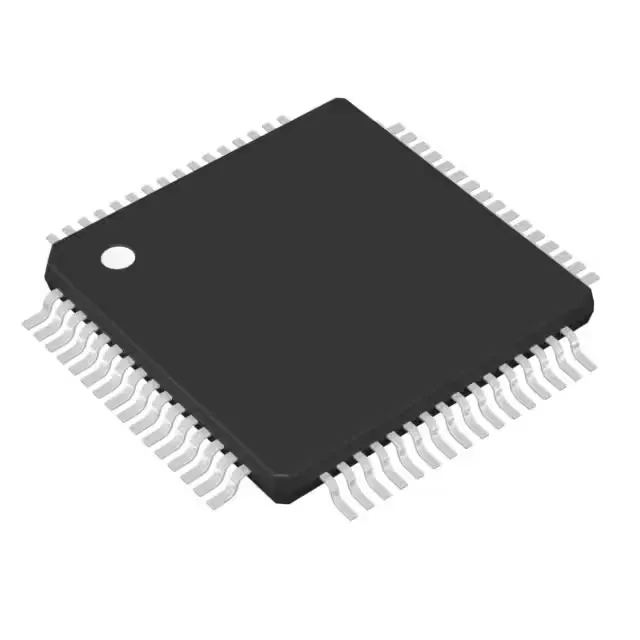
Texas Instruments MSP430FR5888IPMR — Microcontrollers & Processors (MCU / MPU / DSP)

MSP430FR5888IPMR 16-bit MCU, 96KB FRAM, 16MHz, 64-LQFP

MPNMSP430FR5888IPMR
Obsolete

Texas Instruments MSP430™ FRAM series, MSP430FR5888IPMR, 16-bit MCU with MSP430 CPUXV2 core at 16MHz, 96KB FRAM program memory, 2K x 8 RAM, 48 I/O, 12x12b ADC, 1.8V-3.6V supply, -40°C to 85°C, 64-LQFP.

$8.1830Ref. price · indicative, final on quote
StockContact for availability
MOQ1 pcs
  • 100% new & originalTraceable channels only — no refurbs, no pulls, no remarked parts.
  • Date & lot codes on quoteStated per line before you commit; label photos on request.
  • MSL-compliant ESD packingMoisture-sealed bags with indicator cards; reels photo-verified.
  • PayPal buyer protectionPay by T/T, PayPal or Payoneer — card payments covered end to end.

Specifications

MSP430FR5888IPMR Technical Specifications
ParameterValue
SeriesMSP430™ FRAM
Mounting typeSurface Mount
Oscillator typeInternal
Program memory typeFRAM
Voltage - supply (Vcc (Vdd))1.8V ~ 3.6V
Operating temperature-40°C~85°C(TA)
Speed16MHz
PackageTape & Reel (TR)
RAM size2K x 8
Core size16-Bit
PeripheralsBrown-out Detect/Reset, DMA, POR, PWM, WDT
ConnectivityI²C, IrDA, SCI, SPI, UART/USART
Number of i (O)48
Core processorMSP430 CPUXV2
Case64-LQFP
Data convertersA/D 12x12b
Program memory size96KB (96K x 8)

Product details

Its program memory is 96 KB of FRAM — a non-volatile storage technology that combines the fast write speed and low power of RAM with the data retention of Flash, with essentially unlimited write endurance. This makes it a strong fit for applications that log data frequently, update firmware over the air, or need to maintain configuration state without a separate EEPROM.

96 KB FRAM — the endurance and write-speed advantage

The 96 KB FRAM program memory is the headline feature here. Unlike conventional Flash, FRAM writes at bus speed without a page-erase cycle, so the MCU can treat a portion of program space as data-logging or configuration storage without wearing out the memory. For a design that writes calibration constants every power cycle or streams telemetry into a circular buffer, this avoids the 100k-cycle endurance ceiling of typical embedded Flash. The 2K x 8 RAM handles stack and scratchpad data; the FRAM handles the rest.

16 MHz CPUXV2 core with 48 I/O and 12-bit ADC

The 16 MHz clock rate on the MSP430 CPUXV2 core is enough for moderate sensor fusion loops, Modbus/RS-485 polling, and real-time control with PWM peripherals. The 48 I/O lines in the 64-LQFP package give room for parallel LCD interfaces, keypad matrices, or multiple sensor inputs. The 12-channel, 12-bit ADC (A/D 12x12b) covers analog front-end tasks like thermocouple, strain-gauge, or current-sense readings without an external converter.

1.8V to 3.6V supply — single-rail battery or regulated bus

The brown-out detect and POR peripherals are integrated, so the reset circuit needs only a pull-up and a decoupling cap.

The MSP430FR5888IPMR carries an Obsolete product status.

Frequently asked questions

Where can I buy MSP430FR5888IPMR and what is the price?

Submit an RFQ through this listing to get a real-time price and lead-time picture from our multi-supplier network.

What is the replacement for MSP430FR5888IPMR?

The evidence does not list an official TI successor order code for the MSP430FR5888IPMR. The closest pin-compatible alternative in the MSP430 FRAM family would be a current-production variant with similar peripheral set and package — check the MSP430FR5889IPMR (higher memory density) or the MSP430FR5994IPMR (higher performance) as starting points for a qualification effort. Verify pin compatibility against the respective datasheets before committing a board spin.

What is the difference between MSP430FR5888IPMR and MSP430FR5889IPMR?

The MSP430FR5889IPMR is a higher-density sibling in the same MSP430 FRAM family. The primary difference is program memory size — the MSP430FR5888IPMR has 96 KB FRAM, while the MSP430FR5889IPMR typically carries 128 KB FRAM. Both share the same 64-LQFP package, 16-bit CPUXV2 core at 16 MHz, 48 I/O, and 12-bit ADC. The FRAM step-up matters if your firmware image or data-logging buffer exceeds the 96 KB ceiling.