48 KB FRAM — what it changes for the BOM
That changes the firmware-update strategy: you can treat the code space like EEPROM and wear-level in software, or skip the external serial EEPROM entirely for calibration and configuration data. The 14-channel 12-bit ADC and the I²C, SPI, and UART interfaces cover the sensor-interface and control-loop needs of an industrial or instrumentation node.
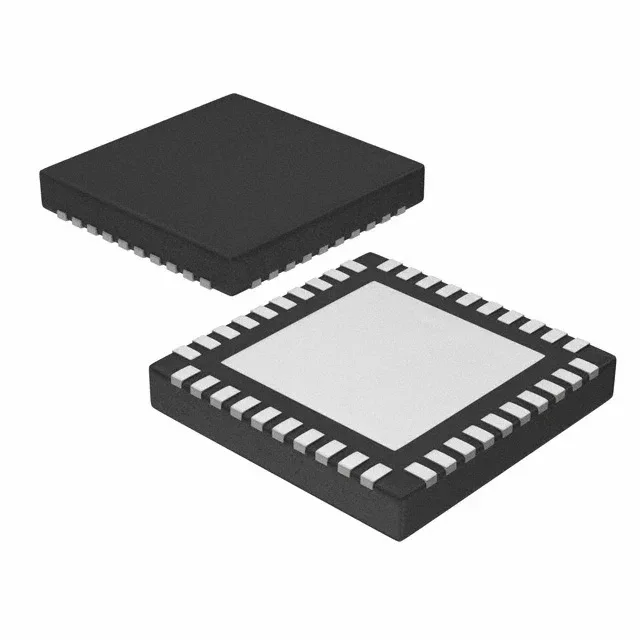
40-VQFN package — footprint and thermal reality
The 33 I/O lines route on two or four layers without trouble, but the fine pitch means the solder-paste stencil aperture needs a 1:1 ratio on the pad openings — no area reduction — to avoid head-in-pillow on the centre pad.
Supply range and oscillator — no external crystal needed
The internal oscillator means you can skip the external crystal in designs that tolerate the ±1% to ±3% accuracy over temperature — the BOM saves a component and a pair of load capacitors. For precision timing (RTC, baud-rate generation), an external watch crystal still fits the I/O budget.
For a production BOM this means no schedule risk from a forced redesign in the next several years. The base product number MSP430FR5858 covers the whole density family, so if a future revision needs more memory or a different peripheral set, the migration stays within the same 40-VQFN footprint.