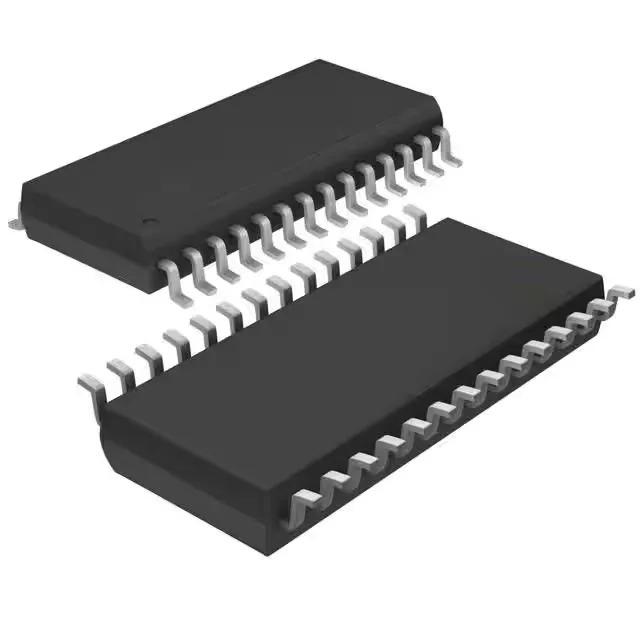
FRAM-based 16-bit MCU for low-power sensing and control
The MSP430FR5738IPW: Its program memory is 16 KB of FRAM — a non-volatile memory that combines the fast write speed and low power of SRAM with the data retention of Flash, without the page-erase overhead. The 21 general-purpose I/O lines and on-chip oscillators reduce external component count.
What 16 KB FRAM means for your BOM
Endurance is orders of magnitude higher than EEPROM or Flash, so you can use the FRAM as both code store and data logger without wear-leveling. That eliminates a separate serial EEPROM or SRAM from the BOM for many sensor-node and metering designs. The 1K x 8 RAM is modest — enough for call stacks and small buffers in control loops, but a data-heavy application will need to use FRAM for variables. The 16-bit register-rich architecture makes the RAM go further than an 8-bit core with the same figure.
Serial connectivity and peripheral set
LINbus support opens door to low-cost automotive subnets for window lifts, seat controls, or mirror adjustment. The IrDA module is useful for contactless configuration in sealed enclosures. The internal oscillator means no external crystal for many applications, though the 24 MHz speed likely requires the internal DCO with FLL for accuracy.
Housed in a 28-TSSOP (4.40 mm width, 0.65 mm pitch), the MSP430FR5738IPW is a surface-mount device suited for automated assembly. The 28-pin count with 21 I/O leaves seven pins for power, ground, and oscillator — a dense but routable package for two-layer boards.
The product status is Active, with no LTB risk over the typical design lifecycle.