FRAM changes the memory game on this MSP430
FRAM is non-volatile like Flash, yet writes at near-SRAM speed with essentially unlimited endurance — no erase cycles, no write-before-erase penalty. The 512 x 8 RAM handles the stack and scratchpad. Running at 16 MHz from an internal oscillator, this MCU draws the characteristic MSP430 sub-milliamp active current, though the exact figure depends on the clock tree configuration and peripheral load.
Integrated LCD controller — one less chip on the BOM
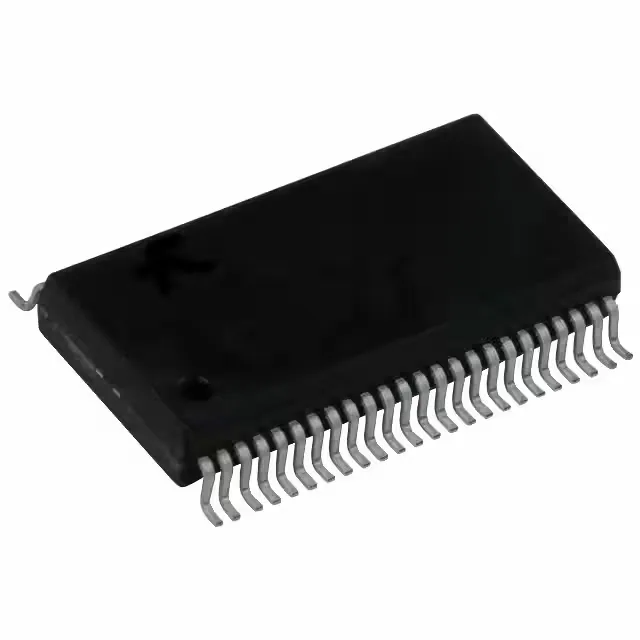
A standout peripheral is the integrated LCD driver, which can directly drive a segment LCD panel without an external display controller IC. For a blood-glucose meter, thermostat, or gas-pump display, that saves board space, reduces BOM cost, and simplifies the firmware — the MSP430's LCD module handles the multiplex timing and contrast control in hardware. The 44 general-purpose I/O pins, many of which double as LCD segment or common outputs, give you flexibility to lay out the display traces without fighting the pinout. The 48-TSSOP package (0.240" body width, 6.10 mm) is a fine-pitch surface-mount footprint that routes easily on a two-layer board. The 0.5 mm lead pitch demands careful solder-paste stencil design, but it is a standard package for this I/O count.
Peripheral set for sensor-heavy designs
The 8-channel 10-bit ADC is adequate for reading thermistors, potentiometers, or simple analog sensors; if you need higher resolution, an external delta-sigma ADC over I²C is the usual pairing. The brown-out detect and POR circuits mean you can skip an external supervisor IC in many designs, as long as the supply ramp meets the datasheet timing. Brown-out reset and the watchdog timer are both present, so a basic safety-net architecture is built in.
For a new product introduction, this part does not carry the supply-chain risk of an NRND or obsolete device. The base product number MSP430FR4131 covers a family of density and package variants, so if a future revision needs more memory or a different footprint, there is a migration path within the same family without a complete firmware rewrite. No special handling or exemption paperwork is needed for shipping into regulated markets.