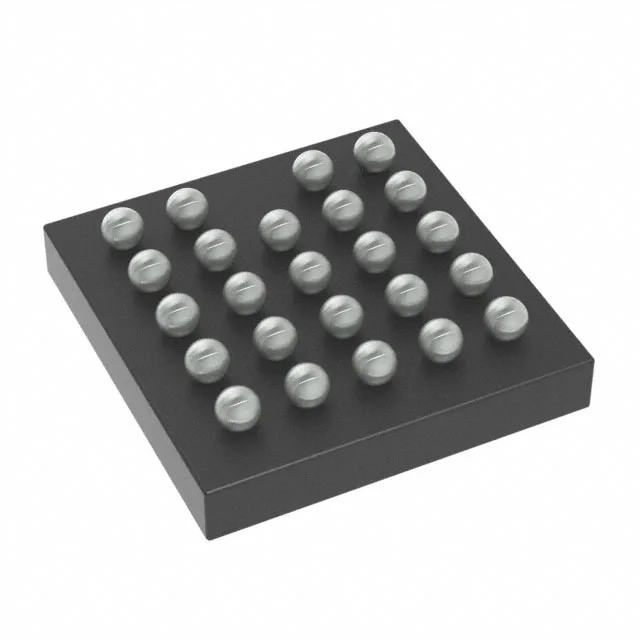
Its program memory is 8.5 KB of FRAM — a non-volatile memory that writes at near-SRAM speed with essentially unlimited endurance, so you can log data or update firmware in the field without worrying about Flash wear.
FRAM vs Flash — why it matters for the BOM
FRAM writes at bus speed and consumes less energy per write than Flash or EEPROM. For a design that stores calibration constants, event counters, or configuration data on every power cycle, FRAM eliminates the erase-before-write step and the wear-leveling code that Flash demands. The 8.5 KB program space is modest — suited for sensor nodes, capacitive touch controllers, or simple control loops — but the write endurance is effectively unlimited, so the part can log data continuously without sector management.
Package and PCB fit
The 17 I/Os are all 3.6 V-tolerant on the supply rail, so level shifting is not needed for 3.3 V peripheral logic. Decoupling should follow the recommended 100 nF per supply pin plus a 4.7 µF bulk cap — the DSBGA's small footprint makes via-in-pad or microvia routing the practical choice for the inner balls.