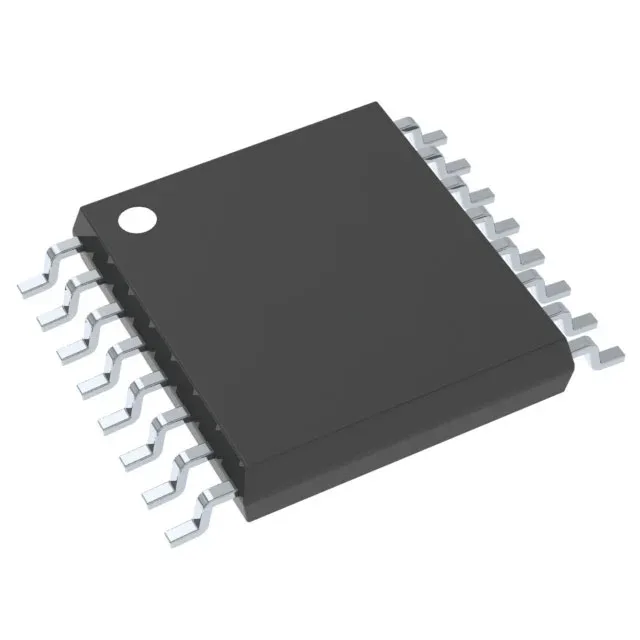
The MSP430FR2522IPW16: For a battery-powered sensor that records a reading every minute, FRAM endurance (typically 10^15 write cycles) means the memory outlives the product. The 2K x 8 RAM is the volatile scratchpad for stack and variables; the FRAM reduces RAM pressure because calibration constants and state tables can live in program space and be updated in-place. The 16 MHz core speed sets the throughput ceiling for the MSP430 CPU16 — enough for real-time capacitive touch scanning (Cap Sense peripheral,) and PWM generation for LED dimming or motor control, but not for heavy DSP or floating-point math.
Package, I/O, and supply — the board-fit constraints
The 11 I/O lines must cover the sensor inputs, display interface, and any serial bus; with I²C, SPI, and UART on-chip, two or three pins get consumed by the bus, leaving 8-9 for discrete signals. Supply range is 2V to 3.6V — this maps to a single-cell Li-ion (3.0-4.2V) or two alkaline cells (2.4-3.0V) without a regulator. The internal oscillator saves the external crystal for applications that can tolerate the ±1-2% accuracy of the on-chip RC. Industrial temperature grade -40°C to 85°C covers outdoor enclosures, factory-floor panels, and under-hood auxiliary modules — the FRAM retains data across the full range without refresh.
Active lifecycle and sourcing posture
ROHS3 compliant. The base product number is MSP430FR2522, which covers the whole family variant matrix. No stock-holding claim — lead time is per-RFQ.