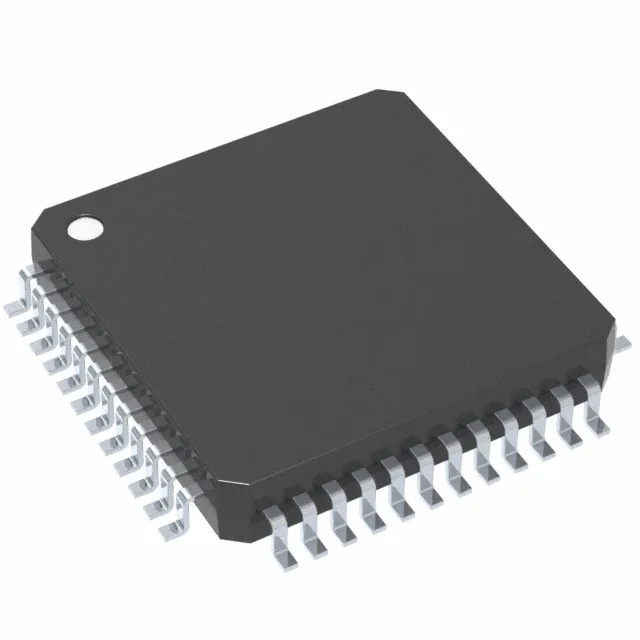
FRAM-based 16-bit MCU for industrial mixed-signal control
This makes it a strong fit for applications that log data, update configuration parameters frequently, or need low-power nonvolatile storage without wear-leveling overhead. On-chip analog peripherals include a 12-channel 12-bit ADC and a 4-channel 12-bit DAC, reducing the need for external signal-conditioning components in sensor interface and closed-loop control designs. IrDA support is present for optical isolation links where galvanic isolation is needed without optocouplers.
The 24 MHz clock rate sets the performance ceiling for this MCU. For applications that need a precise timebase (e.g., real-time clocks or baud-rate generation), an external crystal can still be connected to the dedicated oscillator pins.
FRAM: the real differentiator vs Flash MCUs
FRAM writes at bus speed — no erase-before-write cycle, no page-program delay. The 16 KB FRAM serves as both program memory and data storage.
Package and footprint: 48-LQFP (7x7 mm)
Brown-out detect and POR are integrated, so external reset supervision is not needed for most designs.
The part is ROHS3 compliant.