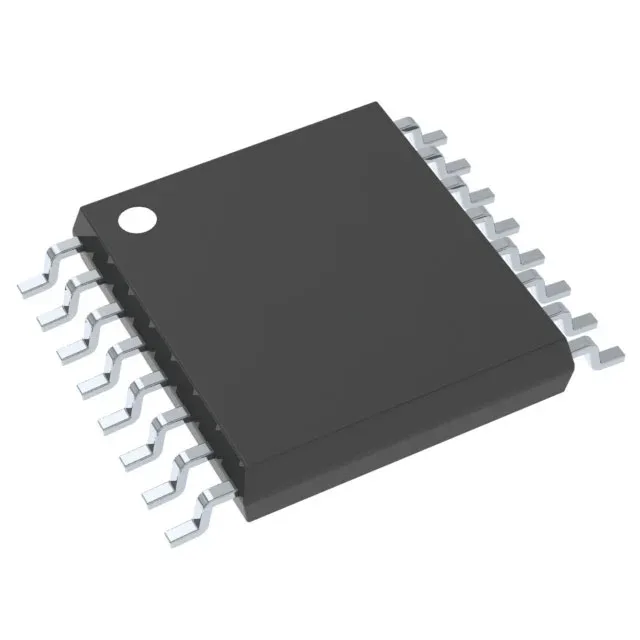
FRAM unified memory — no EEPROM needed
The MSP430FR2110IPW16R integrates 2KB of FRAM (ferroelectric RAM) as its program memory, which also serves as non-volatile data storage — no separate EEPROM or flash wear-leveling required for frequent writes. FRAM endurance is orders of magnitude higher than flash, so field-update firmware or data-logging counters don't erode the memory. Backed by 1K x 8 of SRAM for stack and runtime variables, this 16-bit MSP430 CPU16 core runs at up to 16 MHz — enough for sensor polling, low-speed motor control, or human-interface tasks where the FRAM write speed is the throughput limiter, not the core.
Peripheral set and I/O for a compact control node
Twelve general-purpose I/O lines are available on the 16-TSSOP package, along with an 8-channel 10-bit ADC that samples analog inputs from temperature sensors, potentiometers, or current-sense resistors. Serial connectivity covers I²C, SPI, and UART (via the SCI/USART peripheral), so this MCU can talk to common sensor modules, memory chips, or a host controller on a single bus.
Supply current scales with clock speed and active peripherals; the FRAM retains data down to 1.8 V, so a simple capacitor-backed hold-up circuit preserves state through a brief power loss without a supercap or battery.
Package and board-fit
Housed in a 16-TSSOP (4.40 mm width, 0.65 mm pitch), the MSP430FR2110IPW16R is a surface-mount package that routes cleanly on a two-layer board. The 0.65 mm pitch does not require via-in-pad or blind vias — a standard 0.30 mm trace between pads is feasible with a decent PCB shop.