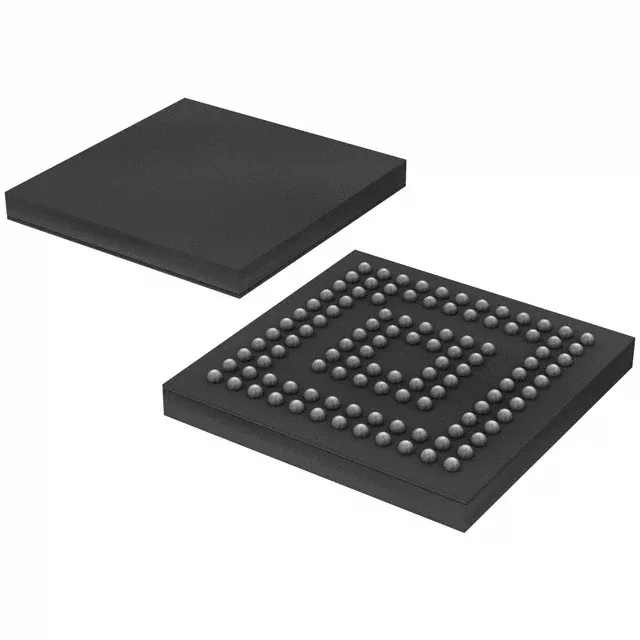
There is no official TI successor listed for this specific order code; if you need a drop-in replacement, you will need to evaluate pin-compatible MSP430FG4618 variants in the same 113-BGA Microstar Junior footprint, or plan a redesign around a current MSP430 device.
8 MHz core with 16-bit CPUX — what it handles
The MSP430 CPUX core runs at 8 MHz, which is modest by today's standards but sufficient for low-power sensor monitoring, data logging, and control loops where battery life matters more than throughput. The 16-bit data path handles 16-bit arithmetic in a single cycle, and the hardware multiplier accelerates multiply-accumulate operations for signal processing. At 8 MHz, the flash wait state is zero, so instruction fetch does not stall — the core can sustain one instruction per clock on most operations.
The 256 B of additional Flash and 8 KB RAM are available.
On-chip analog: 12-bit ADC and DAC
The 12-bit ADC with 12 channels and dual 12-bit DAC reduce external analog components.
113-BGA Microstar Junior — layout and rework
The 113-ball BGA in the Microstar Junior package (7x7 mm) is a fine-pitch array that requires a multi-layer PCB with microvias or blind vias for fanout.
The MSP430FG4618IZQW includes a rich set of peripherals: brown-out detect, DMA, LCD driver, POR, PWM, and watchdog timer. The internal oscillator means no external crystal is required for basic operation, though an external clock can be used for tighter timing.