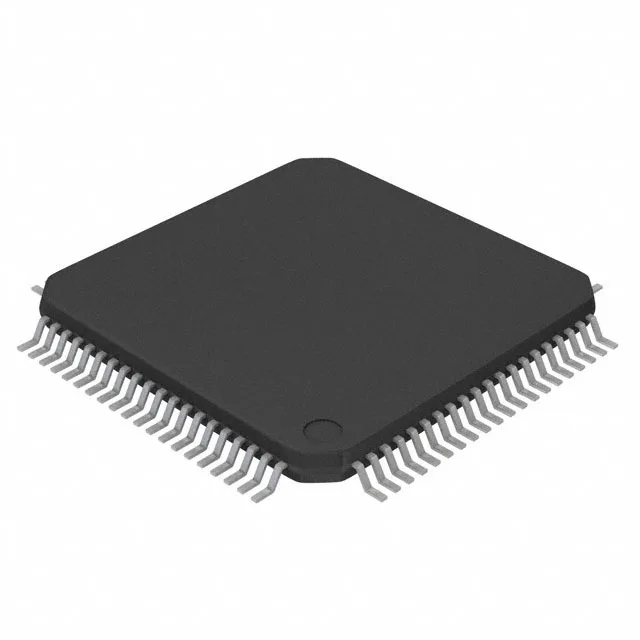
The MSP430 CPU16 runs at 8 MHz, which is the ceiling for this ultra-low-power family. At that speed the flash needs zero wait states, so instruction fetch is single-cycle — no pipeline bubble to budget for. The internal oscillator is stable enough for UART and SPI timing at 8 MHz, but if you need a precision baud clock for the USART at higher rates, plan on an external crystal. The 8 MHz limit also sets the ADC sampling rate: with the 12-bit ADC clocked from the internal DCO, you get about 200 ksps aggregate across the 12 channels — adequate for multi-channel sensor scanning in a panel meter or flow controller.
Integrated LCD driver and dual DAC — fewer external parts
This is one of the few MSP430x4xx parts that packs both an LCD segment driver and dual 12-bit DACs on-chip. The LCD controller drives up to 160 segments directly, which eliminates a separate display driver IC in metering and instrumentation panels. The two DACs can generate analog setpoints or bias voltages without external converters. Combined with the 12-channel 12-bit ADC and the DMA controller, the FG439 can run a sensor-front-end plus display update loop without waking the CPU for every conversion — the DMA moves ADC results to RAM while the core sleeps at sub-µA levels.
Industrial temperature range and 80-LQFP footprint
The 48 GPIOs give enough headroom for a parallel LCD data bus plus a handful of sensor interrupts and a UART/SPI port.
The brown-out detect and POR circuits are built in — no external supervisor needed for reliable power-up sequencing. At 8 MHz active current is around 2.5 mA typical; in LPM3 (real-time clock + LCD retention) the draw drops to below 2 µA.