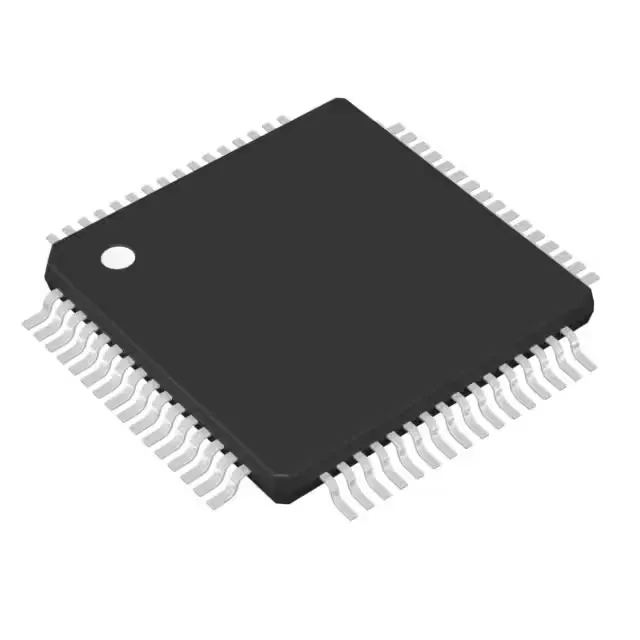
Energy metering MCU with integrated sigma-delta ADC
The peripheral set includes a brown-out detect/reset, POR, PWM, watchdog timer, and an LCD driver, with SPI and UART/USART connectivity.
The 32 KB Flash (32K x 8 plus 256 bytes) holds the metrology firmware, calibration constants, and communication stack. The 1 KB RAM is tight for buffering ADC samples and protocol frames — expect to manage the data buffer carefully if logging interval data or running a full Modbus RTU stack. For designs that need more headroom, the MSP430x4xx family offers higher-density Flash options in the same 64-LQFP footprint, though the ADC peripheral mix may differ.
The three 16-bit sigma-delta ADCs are the reason this part exists. They are designed for direct connection to current and voltage sensor outputs (shunts, CTs, resistive dividers) in energy metering front-ends. The 16-bit resolution gives enough dynamic range for Class 1 or Class 2 meter accuracy with proper external analog conditioning. No external ADC is needed, which saves BOM cost and board area. The sigma-delta architecture inherently rejects 50/60 Hz line noise, but the digital filter settling time must be accounted for in the measurement update rate.
Brown-out detection is included on-chip, so the reset circuit is minimal — just a decoupling cap and the supply. At 3.6 V the core runs at full 8.4 MHz; at 1.8 V the maximum speed may be lower per the datasheet frequency vs. voltage curve, which matters for battery-powered designs that scale voltage to save power.
It is ROHS3 compliant. For dual-sourcing resilience, the MSP430FE427IPM (non-tape-and-reel suffix) is the same die in the same package, differing only in shipping media.