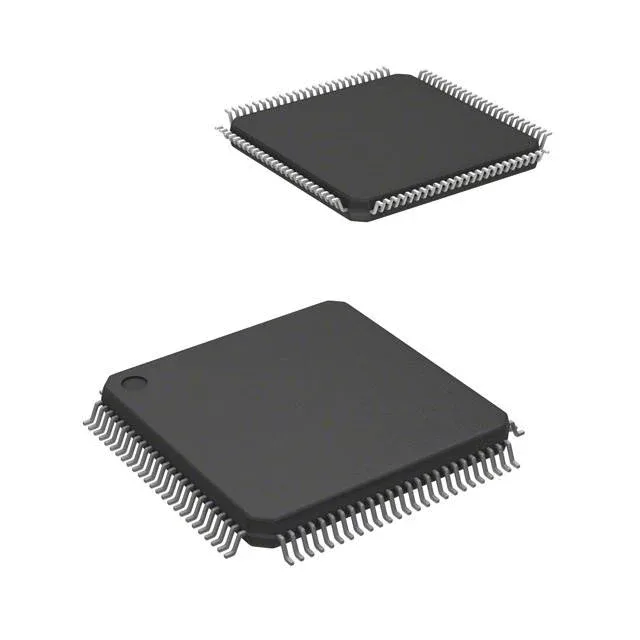
Seven 24-bit sigma-delta ADCs on a 25 MHz 16-bit core
Its standout feature is the integration of seven 24-bit sigma-delta analog-to-digital converters, purpose-built for polyphase energy metering, power quality monitoring, and multi-channel precision measurement.
What the 24-bit sigma-delta converter buys the design
Seven independent 24-bit sigma-delta ADCs let a single MSP430F6775AIPZ handle three-phase voltage and current sensing plus a neutral channel without external multiplexing or multiple ADC chips. Each converter runs simultaneously, so the phase relationships between channels are preserved — critical for accurate active and reactive power calculations. The 24-bit resolution gives enough dynamic range to resolve millivolt-level signals in the presence of large line-frequency fundamentals, reducing the need for external gain stages. The LCD driver on-chip can directly drive a segment display for local readout, trimming the BOM by one display controller.
Package and supply considerations for the layout
The MSP430F6775AIPZ comes in a 100-pin LQFP package (14x14 mm body). The 62 I/O lines give plenty of headroom for connecting to external sensors, communication transceivers, and a display. The internal oscillator is available, saving a crystal on cost-sensitive boards, though an external crystal can be added for tighter timing on the sigma-delta sampling clock. Surface-mount assembly is standard — no special reflow profile beyond typical LQFP handling.
For new designs, this avoids the last-time-buy risk that comes with NRND or EOL parts. If a second source is needed for dual-supply resilience, TI's MSP430F6xx family includes pin-compatible variants with different Flash/RAM and ADC counts — review the specific memory and peripheral requirements before selecting an alternate.