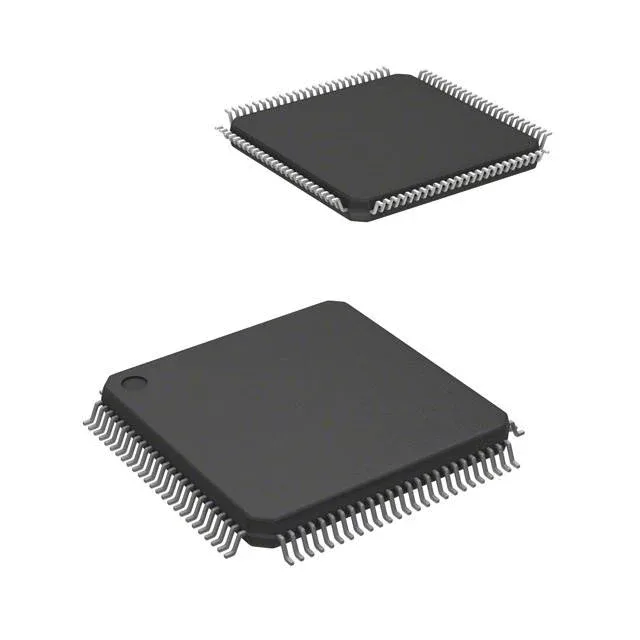
What this MSP430 variant brings to the meter and industrial ADC front-end
The MSP430F6768AIPZR: The distinguishing feature is the set of six 24-bit sigma-delta analog-to-digital converters — this part was designed for polyphase energy metering, precision instrumentation, and industrial sensor acquisition where multiple simultaneous high-resolution ADC channels are needed.
Six 24-bit sigma-delta ADCs — the spec that decides the fit
Most MSP430 derivatives carry one or two general-purpose SAR ADCs. The F6768A integrates six independent 24-bit sigma-delta converters, which changes the design approach: you can sample three-phase voltage and current simultaneously without external multiplexing or phase-skew correction. For a three-phase energy meter that means one chip handles all six channels (three voltages, three currents) with the digital filtering and post-processing done on the CPUXV2 core. The 25 MHz clock gives enough headroom for the math — metrology libraries from TI run comfortably within that cycle budget. If your application only needs one or two ADC channels, this part is overkill; a smaller MSP430F5xx with a single SAR ADC would save BOM cost and board area.
The 512 KB program Flash is generous for a 16-bit MCU in this class. A typical energy-meter firmware image with TI's metrology library, communication stacks (UART, SPI, I2C, LINbus, IrDA), and LCD driver code fits in under 200 KB, leaving room for field-upgradeable bootloader and parameter tables. The 16 KB RAM is the tighter resource: each 24-bit ADC result consumes 3 bytes, and with six channels running continuous conversions the raw data stream fills buffers quickly. Plan to process and discard samples in the foreground loop or use DMA to move data directly to memory without CPU intervention. The peripherals block lists DMA support, which is worth confirming in the full datasheet for your specific buffer strategy.
Package and rework — 100-LQFP is hand-serviceable
The 100-LQFP (14x14 mm body) has 0.5 mm pitch gull-wing leads. This is a rework-friendly package: a hot-air station with a fine nozzle can remove it cleanly, and the exposed leads make visual inspection and touch-up straightforward. The 14x14 mm footprint is large enough that adjacent passive components won't crowd the reflow zone. No hidden thermal pad underneath, so you don't need a bottom-side preheater for most boards.
For volume commitments or long-term supply agreements, the active status means standard lead times apply through the distribution channel — no allocation or end-of-life timeline to manage at this point.
The LINbus interface is useful for automotive-adjacent industrial networks. The LCD controller can drive segment displays directly, saving a separate display driver chip in cost-sensitive metering and control-panel applications.