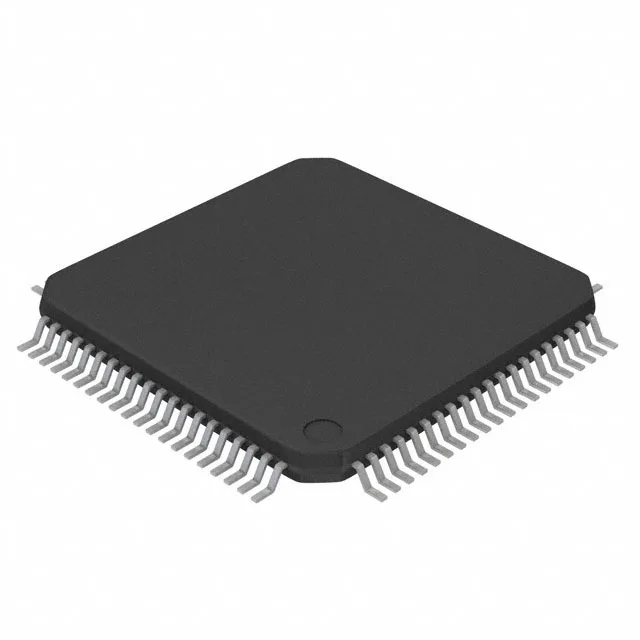
16-bit MSP430 with integrated 24-bit sigma-delta ADC and LCD drive
The distinguishing feature set includes a dual 24-bit sigma-delta ADC alongside a 5-channel 10-bit SAR ADC, plus an integrated LCD driver capable of directly driving segment-display panels.
The 25 MHz clock rate on the MSP430 CPUXV2 core is the ceiling for instruction throughput. For a 16-bit RISC architecture, this is a mid-range speed that handles real-time control loops, periodic ADC reads, and display refresh without external timing components — the internal oscillator is rated for this speed. If your firmware has tight interrupt latency requirements or heavy math in the 24-bit ADC post-processing, budget the MIPS against the 25 MHz limit; the core does not have a hardware multiplier, so multiply-heavy algorithms will eat cycles.
The 32 KB Flash (32K x 8) and 2K x 8 SRAM are the memory resources for this MCU. The Flash is sufficient for a moderate-complexity application — think a multi-rate energy meter with LCD display, UART communication, and a few calibration tables. The 2 KB RAM is tight for buffering; if your application needs large data arrays or multiple UART ring buffers, verify the RAM budget early. Flash endurance is the standard MSP430 100k-cycle sector erase, suitable for field-updateable firmware with wear-leveling in the bootloader.
Dual 24-bit sigma-delta ADC — the precision analog front-end
The two 24-bit sigma-delta ADC channels are the headline analog feature of the MSP430F6721IPN. These are designed for direct connection to current and voltage sensors in energy measurement — think shunt resistors or current transformers with anti-aliasing filters. The 5-channel 10-bit SAR ADC handles auxiliary measurements like temperature or supply monitoring. The 24-bit channels give you the dynamic range to resolve small signals in the presence of large DC offsets, but the noise floor and effective resolution depend on the oversampling ratio and the external analog front-end. For a metering design that needs certified accuracy, the 24-bit ADC is the reason to pick this part over a general-purpose MSP430.
Brown-out detect and POR are integrated, so external reset supervision is optional for most designs. The 80-LQFP package (12x12 mm) is a hand-solderable fine-pitch QFP with 0.5 mm pitch, suitable for two-layer PCBs with careful routing.
The active lifecycle status means the part is still flowing through the supply chain, and we can provide a firm quote for your BOM quantity. No LTB or allocation concerns apply to this line.