The part integrates a 16-channel 12-bit ADC and a dual 12-bit DAC, so a sensor-interface or closed-loop actuator design can skip an external converter.
At 20 MHz the CPUXV2 pipeline executes most instructions in one or two cycles, so a tight 50 µs control loop or a 115200 baud UART interrupt handler has margin.
256 KB Flash and 18 KB RAM — firmware and buffer budget
256 KB of Flash is sized for a moderate application: a USB CDC class driver, a Modbus RTU stack, and a few hundred lines of application code fit without squeezing. The 18 KB RAM (organized as 18K x 8) supports double-buffered USB endpoints and a 4 KB DMA buffer for ADC samples without spilling into stack space.
USB plus serial — one chip talks to everything
The USB peripheral handles device, host, or OTG roles. Alongside it, the serial interfaces cover I²C, SPI, UART, LIN, and IrDA — enough to bridge a legacy RS-485 sensor network to a USB-connected PC or to aggregate data from multiple digital sensors over I²C. With 74 I/O lines in the 100-LQFP package, most of the pins stay available even after wiring up the serial buses.
Package and supply — what to plan for on the board
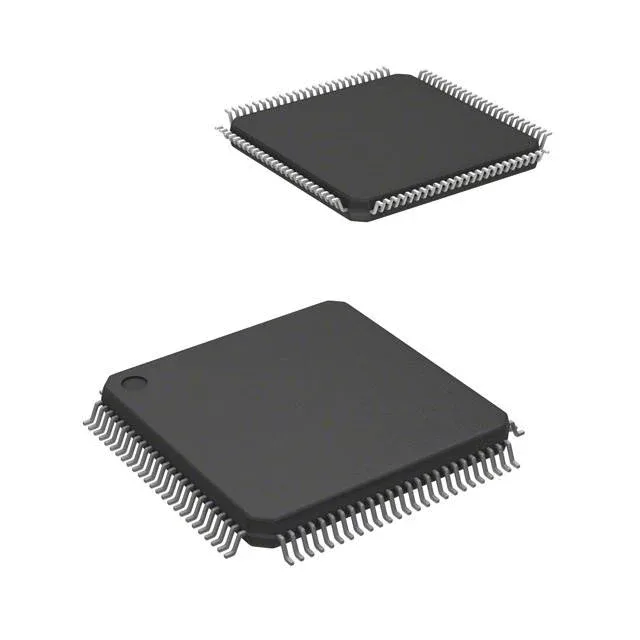
The 100-LQFP (14x14 mm body) is a hand-solderable surface-mount package with 0.5 mm pitch — no BGA rework needed. The internal oscillator and brown-out reset reduce external component count to a decoupling cap and a pull-up on the reset line.