Obsolete — sourcing the MSP430F6634IZQWT for production support
Texas Instruments marks the MSP430F6634IZQWT as Obsolete. This means TI no longer manufactures the part, and the last-time-buy window is closed. For production lines that still carry this order code on the BOM, the supply channel is independent surplus and broker inventory — not the factory or its authorized distributors. No official replacement order code is listed on the TI lifecycle record for this specific package variant (113-BGA Microstar Junior). A board-spin to a different package or a later MSP430F6xx device is the typical migration path, but no pin-compatible direct substitute is documented here.
Core and memory — what the 20MHz and 192KB Flash mean for fit
The MSP430 CPUXV2 core runs at 20MHz. For a 16-bit architecture, this clock rate delivers roughly 16–20 MIPS — enough for real-time control loops in metering, sensor fusion, or USB data streaming, but not for DSP-heavy workloads that would need a Cortex-M4 or a dedicated signal processor. Program memory is 192KB of Flash, with 18KB of RAM. The Flash is plenty for a USB stack plus application code; the 18KB RAM is tight if you buffer full USB packets or run a real-time OS. A firmware engineer should budget the RAM before committing — the USB endpoint buffer alone can consume 2–4KB depending on configuration.
Package and board integration — 113-BGA Microstar Junior
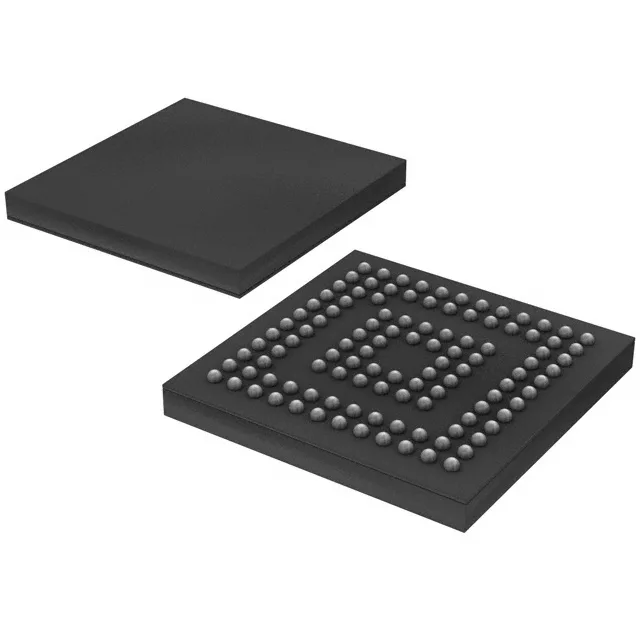
The MSP430F6634IZQWT comes in a 113-VFBGA package, specifically the 113-BGA Microstar Junior with a 7x7 mm body. The 0.50 mm ball pitch requires a 4-layer PCB minimum for fan-out; two-layer boards will struggle to route all 74 I/O plus the supply and ground balls.
Connectivity and peripheral set — USB, I2C, SPI, UART
The MSP430F6634 integrates a USB 2.0 peripheral, plus I2C, SPI, UART/USART, IrDA, and LINbus. The USB module supports device-mode only (no host/OTG), so it fits applications like USB data loggers, HID interfaces, or virtual COM ports. The 16-channel 12-bit ADC handles analog sensor inputs without an external converter. On-chip peripherals include a brown-out detect, POR, DMA controller, PWM, and watchdog timer. The DMA offloads data transfers from the CPU — useful for moving ADC results or USB buffers without stalling the core.