What the 20 MHz core and 192 KB flash mean for your firmware budget
The MSP430F6631IPZ: The MSP430 CPUXV2 core runs at 20 MHz — a 16-bit RISC pipeline that executes most instructions in a single cycle, so the throughput ceiling is higher than the raw clock suggests. The 192 KB on-chip flash and 18 KB RAM leave room for a USB stack, a real-time operating system footprint, and application code without external memory. For a data-logging or sensor-fusion project, the flash holds roughly 48,000 lines of compiled C before the linker starts complaining.
USB plus serial connectivity — one chip talks to the host and the field bus
The integrated USB 2.0 peripheral handles host or device mode without an external PHY — the 48 MHz oscillator is generated on-chip from the internal DCO. Alongside USB, the connectivity block includes I²C, SPI, UART/USART, LINbus, and IrDA, so a single MSP430F6631IPZ can bridge a USB host to a LIN sensor network or log data over UART to a serial console. The 74 general-purpose I/O pins are enough to drive a character LCD, read a keypad matrix, and still leave spare lines for status LEDs.
Industrial temperature grade and supply range — where this MCU lives
The internal oscillator eliminates the external crystal for many applications, though the USB peripheral still requires a stable clock source for full-speed operation.
100-LQFP package — PCB layout and board-fit considerations
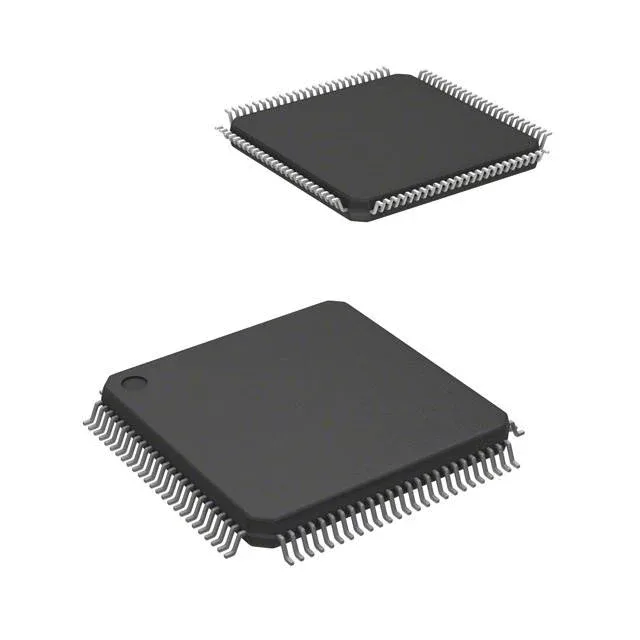
Housed in a 100-pin LQFP with a 14×14 mm body, the MSP430F6631IPZ uses a 0.5 mm pitch that requires a 4-layer PCB for clean fan-out of the inner rows.