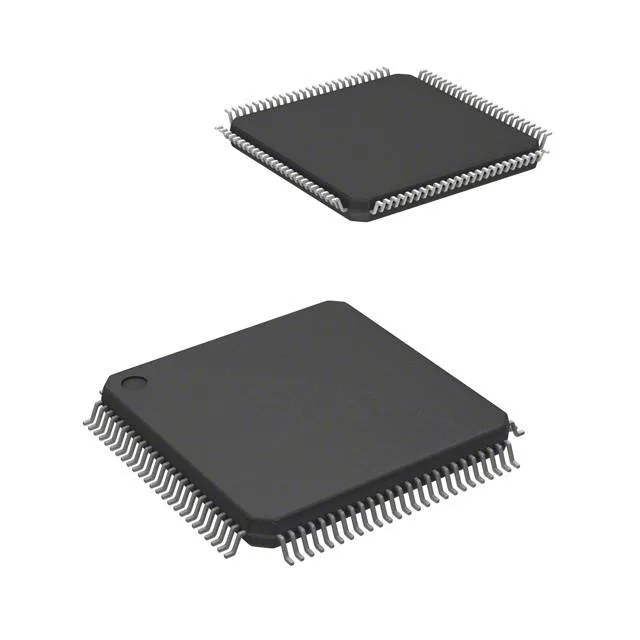
MSP430F5637IPZ — 16-bit MCU with USB and 192 KB Flash
This part integrates a USB 2.0 full-speed interface alongside I²C, SPI, UART, IrDA, and LINbus serial connectivity, plus 74 general-purpose I/O lines.
Peripheral set and deployment context
Typical environments for this class of MCU include industrial data loggers, USB-to-sensor bridges, human-machine interface panels, and medical peripherals where the 16-bit core provides adequate throughput at a lower power footprint than a 32-bit alternative.
Memory sizing and firmware strategy
With 192 KB of Flash and 18 KB of RAM, the MSP430F5637IPZ can host a USB stack, a real-time operating system kernel, and moderate application code without external memory. The 18 KB RAM is sufficient for double-buffered USB transfers, sensor data logging, and communication protocol state machines. The Flash is organized as 192 KB × 8 bits; the RAM as 18 K × 8 bits. For firmware updates over USB, the on-chip bootloader (BSL) supports field reprogramming without a dedicated programmer.
Housed in a 100-pin LQFP with a 14 mm × 14 mm body (0.5 mm pitch), the MSP430F5637IPZ is surface-mount and hand-solderable with standard reflow profiles. The 74 I/O lines are distributed across the four sides, which simplifies fan-out on a two-layer board for many designs. The supplier device package code is 100-LQFP (14x14). This footprint is shared across the MSP430F5xx 100-pin LQFP variants, so a board layout can accommodate multiple Flash/RAM density options with a single PCB spin.