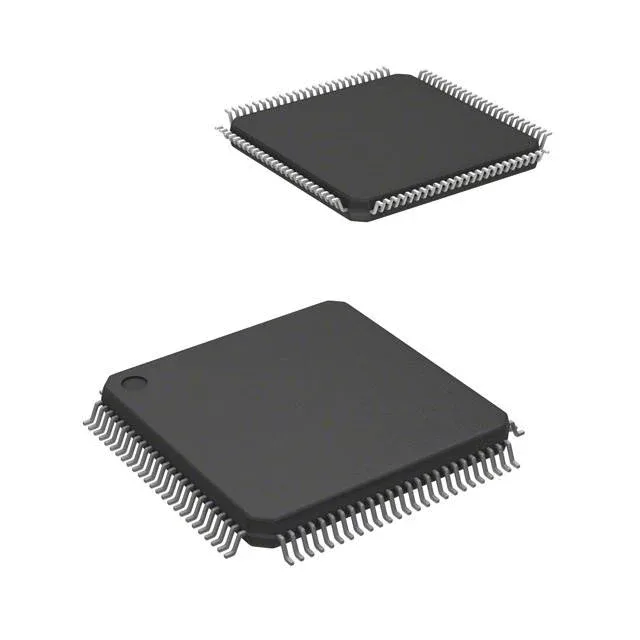
The MSP430F5630IPZR: It runs at 20 MHz and packs 128 KB of program Flash and 18K x 8 bytes of RAM — enough for moderately complex embedded control, data logging, or USB-connected instrumentation. For connectivity you get I²C, IrDA, LIN, SCI, SPI, UART/USART, and USB — a solid mix for talking to sensors, actuators, displays, or a host PC.
At 20 MHz the core can execute most instructions in a single cycle, giving you roughly 20 MIPS. If your application needs more throughput — say, heavy DSP or high-speed data acquisition — you will want to step up to a Cortex-M4 class part. But for the typical MSP430 sweet spot of low-power mixed-signal control, 20 MHz is a comfortable fit.
128 KB Flash and 18K x 8 RAM — sizing the firmware and data space
The 18K x 8 RAM (18 KB) handles a few kilobytes of packet buffers, stack, and global variables. If you need more RAM for large data arrays or a real-time OS, look at the higher-density members of the MSP430F5xx family.
Package and footprint — 100-LQFP (14x14 mm)
The MSP430F5630IPZR comes in a 100-pin LQFP with a 14x14 mm body and 0.5 mm pitch. That is a common footprint — many 100-pin ARM MCUs share the same layout, so board spin for a pin-compatible swap is straightforward if the pinout matches. It is a surface-mount device (SMD) intended for reflow soldering.
Lifecycle reality — this part is obsolete
That means Texas Instruments has stopped production; there is no last-time-buy window left. Any stock you find is new-old-stock or surplus from distribution channels.
We source it from independent distribution — broker, surplus, and excess inventories.