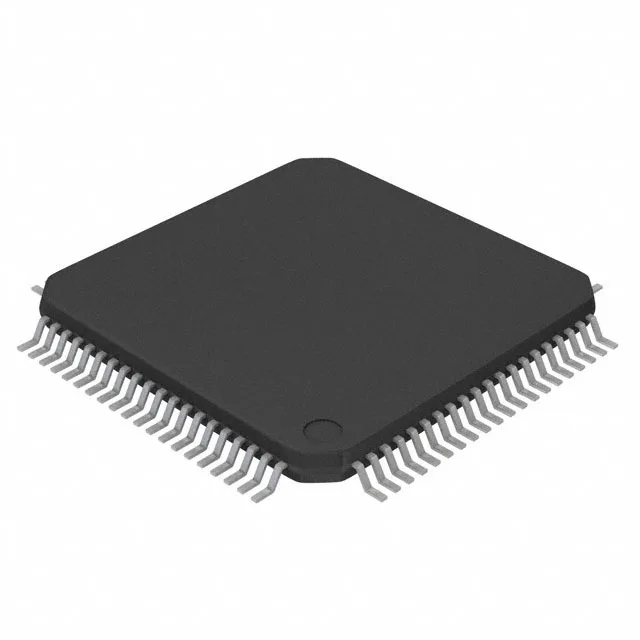
Flash and RAM budget for a USB-connected design
The MSP430F5521IPN packs 32 KB of flash and 8 KB of RAM on a 16-bit core clocked at 25 MHz. For a USB data-logger running a small RTOS or a bare-metal state machine, the flash holds the application plus the USB stack with room to spare — the TI USB API library consumes roughly 8–10 KB, leaving 22+ KB for the control loop and protocol handling. The 8 KB RAM covers the stack heap, USB endpoint buffers (typically 512 bytes per endpoint), and a modest circular buffer for sensor data. If the firmware needs to log a few hundred samples before dumping over USB, the 8 KB RAM is tight — budget the data buffer size before committing the BOM. The DMA controller (listed in the peripheral set) can stream ADC results directly into RAM without CPU intervention, which stretches the effective throughput.
USB PHY on-chip — one less chip on the BOM
The connectivity block also includes I²C, SPI, UART, and IrDA — enough to talk to sensors, an external EEPROM, or a radio module without adding a serial bridge. The 63 I/O lines in the 80-LQFP package give headroom for a parallel LCD, a keypad matrix, and a few spare GPIOs for status LEDs or relay drivers. The 12x12 mm footprint is hand-solderable with a fine-tip iron and a magnifier — no reflow oven required for prototyping.
Industrial temperature and supply flexibility
The internal oscillator trims to 1% accuracy across temperature — good enough for UART baud-rate generation at 115200 bps. For a tighter clock tolerance (USB requires 0.25% for full-speed), feed an external crystal into the LFXT1 or XT2 pins; the MSP430 clock system accepts both.
Active lifecycle — no end-of-life pressure
Sourced through authorized distribution channels. No single-source risk from a phase-out window.