25 MHz CPUXV2 core — performance headroom for control loops
The 16-bit RISC architecture with hardware multiplier accelerates signal processing tasks like sensor compensation and digital filtering. When migrating from an earlier MSP430F2xx or F4xx part, the CPUXV2 adds a 20-bit memory address bus and improved instruction efficiency, so the same code often runs faster at a lower clock setting.
The 6 KB RAM (organized as 6K x 8) is sufficient for USB buffers, communication packet queues, and intermediate sensor data. For designs that need more memory headroom, the MSP430F5xx family offers pin-compatible parts with up to 256 KB Flash and 18 KB RAM — a clean upgrade path without a board spin.
Integrated USB 2.0 — a key differentiator in the 16-bit MCU space
This is a significant BOM simplification for designs that require PC connectivity — data loggers, firmware update dongles, portable instruments, and USB-to-serial bridges.
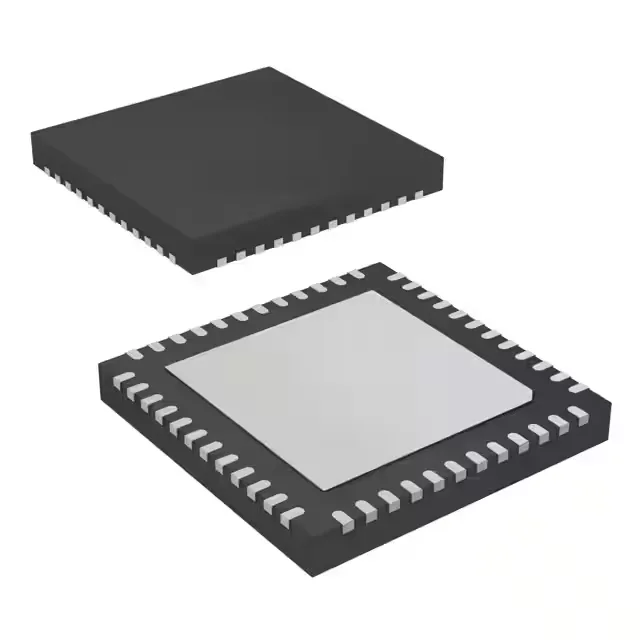
48-VQFN package with exposed pad — layout and thermal notes
The 31 general-purpose I/O pins provide ample connectivity for external sensors, displays, and memory.
The base product number MSP430F5510 covers multiple package and temperature variants, so the IRGZR suffix (48-VQFN, -40°C to 85°C, tape-and-reel) is the specific ordering code for volume assembly.