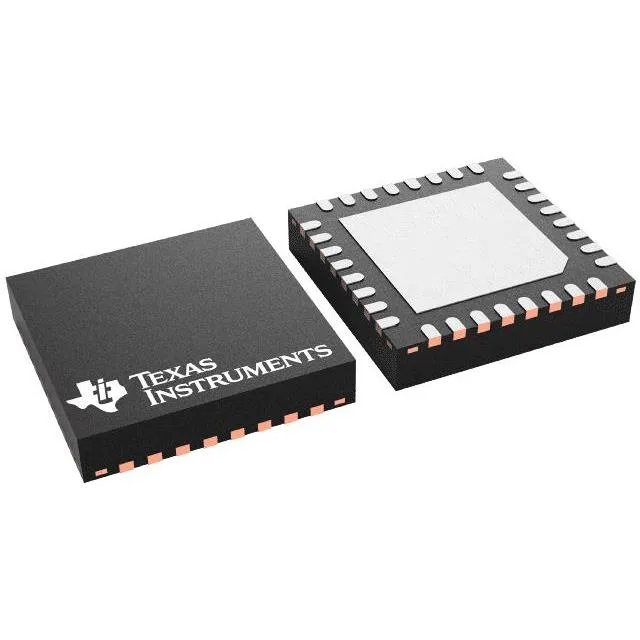
25 MHz MSP430 core with integrated USB 2.0
The MSP430F5508IPT is a 16-bit MCU from TI's MSP430F5xx family, clocked at 25 MHz with the MSP430 CPUXV2 core. The 25 MHz ceiling is the CPU clock; actual throughput depends on flash wait-state insertion at higher frequencies — at 25 MHz the core inserts one wait state, so the MIPS figure is lower than the clock rate alone suggests. On-chip memory is 16 KB of Flash (16K x 8) and 6 KB of SRAM (6K x 8). The 6 KB RAM is the tight spot: a USB CDC or HID stack plus a small application buffer leaves about 2–3 KB for the heap and stack. Budget the firmware footprint early if you plan to use the USB peripheral with a real-time control loop.
Peripheral set and connectivity
Connectivity includes full-speed USB 2.0, I2C, IrDA, LINbus, SCI, SPI, and two UART/USART modules — the USB PHY is integrated, so no external transceiver is needed for device-mode applications. The 31 general-purpose I/O lines are enough for a small HMI or sensor hub with a USB uplink. The DMA offloads the CPU for USB packet transfers and ADC result reads — useful if the application runs a control loop alongside the USB stack. The 8-channel 10-bit ADC (A/D 8x10b) samples at up to 200 ksps in the MSP430F5xx family. For a 10-bit converter, the INL is typically ±1 LSB; the reference is internal, so absolute accuracy depends on Vcc stability.
Package, supply, and temperature grade
The supplier device package is 48-LQFP (7x7). At 25 MHz with all peripherals active, the typical current draw is around 4–5 mA; in LPM3 (low-power mode 3 with ACLK active) it drops to below 2 µA. This covers most factory-floor, outdoor enclosure, and HVAC applications but does not carry AEC-Q100 automotive qualification. For under-hood or cabin electronics, look at the MSP430F5xxQ1 variants.
The base product number is MSP430F5508; the IPT suffix denotes the 48-LQFP tray package. ROHS3 compliant. Sourced through authorized TI distribution and independent channels.