Core and memory — what the 25 MHz ceiling buys you
The MSP430F5324IRGCR runs the 16-bit MSP430 CPUXV2 core at 25 MHz — the maximum clock for this family, delivering roughly 25 MIPS in single-cycle execution. The 64 KB on-chip flash (64K x 8) and 6 KB RAM (6K x 8) are sized for a sensor-fusion or data-logging firmware image that leaves room for a real-time operating system or a communication stack. Program memory is FLASH type, so field updates over the serial bootloader are viable without an external programmer.
Supply and temperature — battery and industrial floor
The internal oscillator eliminates an external crystal for the main clock, though the 25 MHz ceiling requires a stable supply within the rated window. Temperature grade is -40 to 85 °C (TA), the industrial band for factory-floor controllers, outdoor sensor nodes, and automotive cabin applications that do not require AEC-Q100 qualification.
I/O and peripherals — what connects without external parts
47 GPIOs are available on the 64-VFQFN package — enough to drive a small keypad, LED indicators, and a parallel LCD without an external port expander. On-chip peripherals include DMA for memory-to-peripheral transfers without CPU load, PWM for motor or LED dimming, and a brown-out detect and power-on reset that supervise the supply rail. The watchdog timer (WDT) can be configured as an interval timer for wake-up from low-power modes.
Serial interfaces and ADC — sensor and actuator bus
The connectivity block includes I²C, SPI, UART/USART, IrDA, and LIN bus — the LIN interface makes this part suitable for automotive sub-networks like door modules or seat controllers, while I²C and SPI cover the majority of industrial sensor and memory peripherals. The 12-channel, 12-bit ADC can sample analog inputs in scan mode; the 12-bit resolution is adequate for 0-10 V or 4-20 mA sensor signals with an external signal-conditioning stage.
Package — board integration note
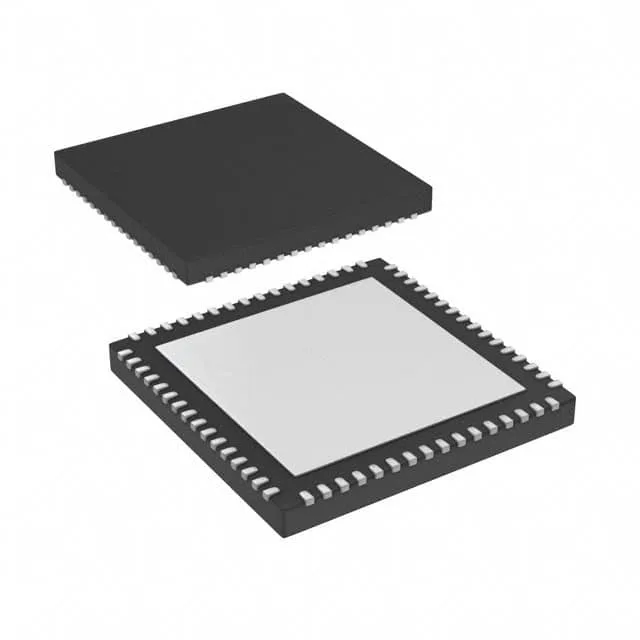
The 64-VFQFN exposed pad package (supplier device package 64-VQFN, 9x9 mm) requires a thermal-via array under the central paddle for junction-to-board heat dissipation. Surface-mount assembly follows standard QFN reflow profiles; the package is RoHS-compliant per TI's standard material declaration.