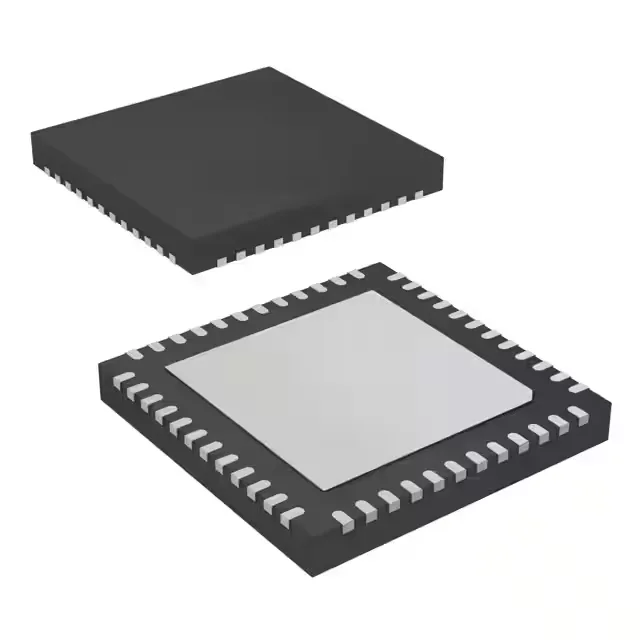
The MSP430F5304IRGZT comes in a 48-VFQFN with an exposed thermal pad (7x7 mm body).
What the 25 MHz core and 8KB Flash mean for the BOM
The MSP430 CPUXV2 runs at 25 MHz — fast enough for a 100 kHz sensor read loop with a 10-bit ADC sample per cycle, but not for heavy DSP or floating-point math. The 8KB Flash (8K x 8) holds a modest control firmware: think a LIN slave node, a temperature monitor with logging, or a simple motor commutation state machine. The 6K x 8 RAM gives room for a 1 KB UART buffer and a few hundred sensor readings. If the firmware needs a USB stack or a TCP/IP offload, this part runs out of memory — step up to the MSP430F5xx parts with 32KB+ Flash.
The Vcc range is 1.8V to 3.6V, so a single Li-ion cell or two alkaline cells power it directly. At 3.3V it is fully compatible with 3.3V logic peripherals — SPI flash, I²C sensors, UART transceivers.
Connectivity and peripherals for industrial sensor nodes
The MSP430F5304IRGZT packs I²C, SPI, UART/USART, LIN, and IrDA on a single die — enough to talk to a MEMS accelerometer over SPI, log data via UART to a host, and handle a LIN bus in an automotive body module. The 31 I/O pins (in a 48-pin package) leave plenty of headroom for a few buttons, LEDs, and a relay driver. The 8-channel 10-bit ADC samples at a rate suitable for battery monitoring or potentiometer feedback, not high-speed audio.
The base product number is MSP430F5304; the IRGZT suffix denotes the 48-VQFN package and tape-and-reel shipping. For dual-sourcing, the MSP430F5xx family includes pin-compatible density variants (e.g., 16KB or 32KB Flash) that drop into the same footprint if the firmware grows.