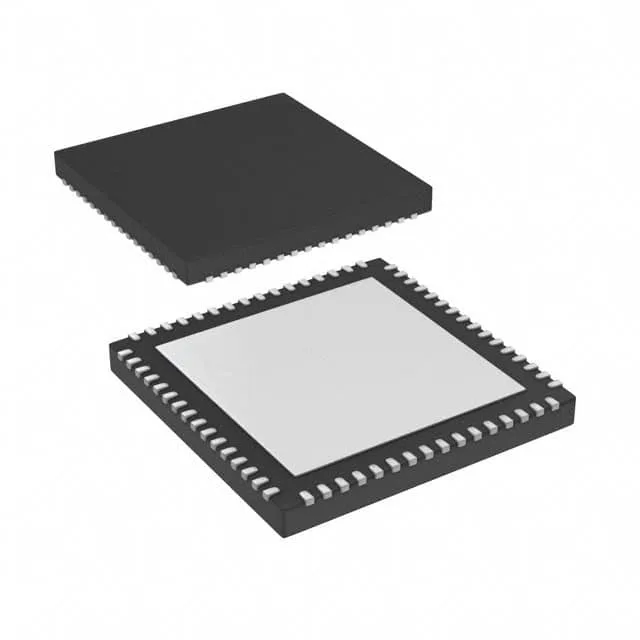
Texas Instruments MSP430F5219IRGCT is a 16-bit MSP430 CPUXV2 microcontroller running at 25 MHz, with 128 KB of Flash program memory and 8 KB of RAM. It integrates a brown-out detect/reset, DMA, POR, PWM, and WDT peripherals, plus I²C, IrDA, SCI, SPI, UART/USART connectivity. The 31 I/O lines are brought out to a 64-VQFN (9x9 mm) exposed-pad package, and the part is rated for -40°C to 85°C operation over a 1.8 V to 3.6 V supply range — a fit for industrial control, sensor nodes, and portable instrumentation where low-power 16-bit processing is called for.
25 MHz core — bus timing and throughput
The 25 MHz clock rate on the MSP430 CPUXV2 core delivers a 40 ns instruction cycle time. That is enough headroom for real-time sensor polling, PID loops, and UART/I²C transaction handling without external clock stretching. For a 16-bit RISC pipeline, 25 MHz is the performance tier that keeps the Flash wait-state overhead negligible at 1.8 V — important when the supply is running near the lower rail.
128 KB Flash / 8 KB RAM — firmware and data budget
128 KB of Flash is sized for a moderate application stack: a bootloader, a real-time kernel, communication protocol libraries (e.g., Modbus RTU or a simple CANopen node), and several thousand lines of application code. The 8 KB RAM supports a few hundred bytes of stack, a modest FIFO buffer for each serial interface, and a small data table. If the design needs larger lookup tables or extensive trace logging, the RAM budget will be tight — plan for external EEPROM or serial SRAM if the application exceeds this footprint.
The exposed pad is also the ground return — verify the PCB layout matches the TI recommended footprint to avoid ground-loop noise coupling into the analog peripherals.