Core specs and what they mean for the BOM
The MSP430F5214IRGZR is a 16-bit microcontroller from the MSP430F5xx family, built around the MSP430 CPUXV2 core clocked at 25 MHz. That clock rate sets the processing ceiling for control loops and protocol handling — enough for a sensor hub or motor-control node that polls at a few kilohertz, but not for real-time audio or video. Program memory is 128 KB of flash (128K x 8), with 8 KB of RAM (8K x 8). The flash holds firmware for moderate-complexity applications — a Modbus gateway or a battery-monitoring stack fits; the RAM budget limits data buffering to a few hundred bytes per channel before you need to page through flash or use the DMA to move blocks.
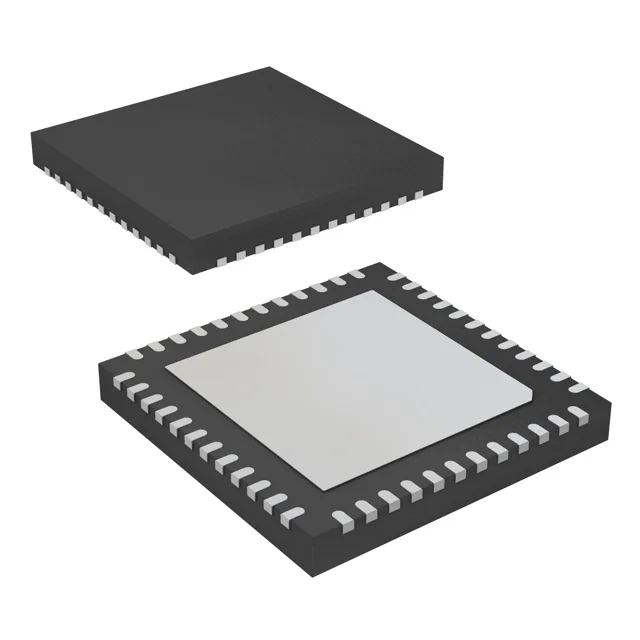
Housed in a 48-VFQFN exposed-pad package (7x7 mm), the MSP430F5214IRGZR needs a thermal land on the PCB to pull heat from the die. The exposed paddle should be soldered to a copper pour with vias to an inner ground plane — skip that and the junction temperature rises faster than the datasheet's theta-JA suggests, especially if the MCU drives I/O at the full 25 MHz. Surface-mount only, supplied on tape and reel. The 17 I/O lines break out to the perimeter pads — the 48-VQFN pitch is 0.5 mm, so a 2-layer board can route most signals, but the exposed paddle forces at least one inner-layer ground pour for thermal relief.
Peripherals and connectivity fit
On-chip peripherals include brown-out detect, POR, DMA, PWM, and a watchdog timer — enough to run a standalone controller without external supervision. The DMA moves data between memory and peripherals without CPU intervention, useful for buffering ADC readings or UART streams without missing a control tick. Connectivity covers I²C, SPI, UART/USART, and IrDA — the common set for sensor buses, serial displays, and industrial fieldbus adapters. No CAN or USB on this variant, so if the application needs a CAN gateway, a different MSP430F5xx member or an external transceiver is required. Internal oscillator eliminates the external crystal for many applications, saving two pins and a couple of capacitors. For timing-critical protocols like IrDA, the internal RC accuracy is sufficient; for a precision RTC, an external 32 kHz crystal can still be added to a timer input.
Lifecycle and sourcing posture
No stock-holding claim — each procurement is quoted per the buyer's quantity and delivery window.