25 MHz core, 16 KB Flash — memory budget for deterministic control
The MSP430F5152IYFFR is a 16-bit microcontroller from the MSP430F5xx series, built around the MSP430 CPUXV2 core running at 25 MHz. This clock ceiling supports deterministic control loops — the 16-bit RISC architecture with single-cycle multiply-accumulate handles sensor fusion and PID updates without jitter from cache misses. On-chip memory comprises 16 KB of Flash and 2 KB of RAM. The Flash holds the application firmware and constant tables; the 2 KB RAM accommodates a small stack and a few hundred bytes of runtime variables. This budget suits a single-purpose controller — a motor commutation loop, a battery monitor, or a keypad scanner — not a multitasking RTOS deployment.
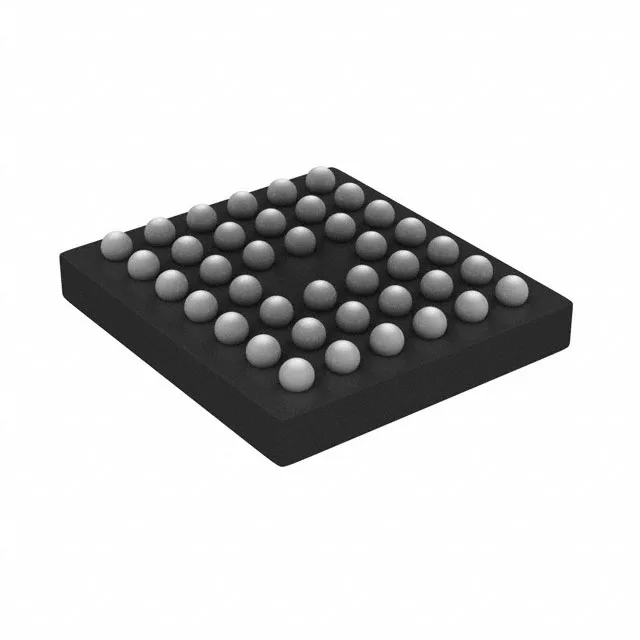
40-DSBGA — 0.4 mm pitch, board-level implications
The part is supplied in a 40-ball DSBGA (die-size ball grid array) package, 0.4 mm pitch. The fine pitch demands a controlled-impedance PCB with micro-vias or via-in-pad for fan-out; a two-layer board is marginal for signal integrity. The package height is approximately 0.6 mm seated, which suits space-constrained assemblies but requires a stencil aperture matched to the 0.25 mm ball diameter for solder joint yield. This covers factory-floor enclosures, outdoor telecom cabinets, and under-hood automotive cabin applications — the die junction temperature stays within the silicon reliability envelope across the full ambient swing.
Supply rail and analog integration
A 3.0 V coin cell or a 3.3 V LDO both work; the brown-out reset (BOR) monitors the rail and holds the core in reset below the threshold, preventing code corruption on a sagging supply. An 11-channel, 10-bit successive-approximation ADC is integrated on-chip. The 10-bit resolution (1024 counts) is adequate for monitoring battery voltage, thermistor temperature, or potentiometer position — it eliminates an external ADC for low-resolution sensor chains. The conversion rate is limited by the ADC clock, not the core speed; typical throughput is in the 200 ksps range.
Serial interfaces and peripheral set
The DMA controller offloads data transfers between the serial peripherals and RAM without CPU intervention, reducing the interrupt load on the 25 MHz core. Additional on-chip peripherals include a PWM timer, watchdog timer, and POR (power-on reset). The PWM timer can generate up to three independent pulse trains for LED dimming or motor speed control; the watchdog provides a failsafe reset if the firmware hangs.
The base product number is MSP430F5152, which covers the full family variant. The IYFFR suffix denotes the 40-DSBGA package and Tape & Reel packaging.