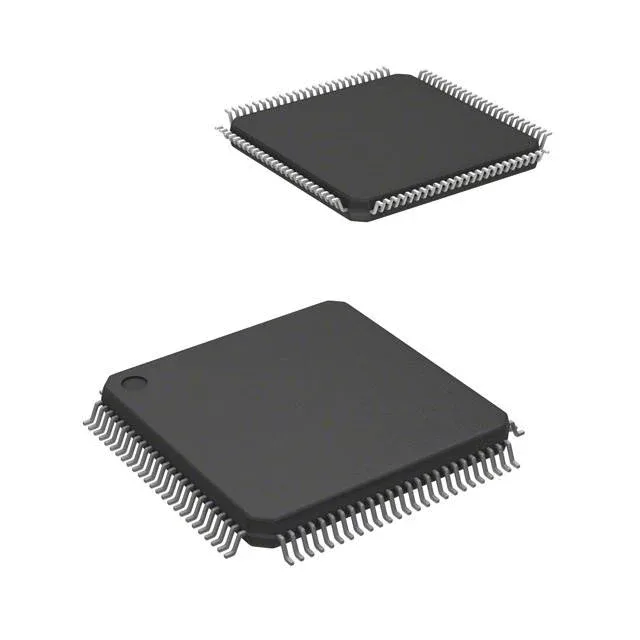
16-bit MSP430 core with integrated LCD drive
It packs 32 KB of program Flash, 1K x 8 of RAM, and runs at up to 8 MHz. What sets this part apart in the MSP430 lineup is the integrated LCD driver peripheral — it can directly drive a segment LCD panel without external glass bias circuitry, making it a fit for metering, portable instrumentation, and human-machine interface panels where power draw under 1 µA in standby matters.
Flash and RAM — sizing the firmware budget
The 32 KB program Flash (organized as 32K x 8 plus 256 bytes of info memory) is the main constraint for firmware engineers. That is enough room for a moderate application stack — a segmented LCD UI, a few sensor calibration tables, and a communication protocol handler — but leaves little headroom for over-the-air update staging or large lookup tables. The 1K x 8 RAM is tight: the stack, global variables, and ADC buffer need careful budgeting. If your algorithm uses floating-point math or large ring buffers, you will be pushing against the RAM ceiling.
8 MHz core speed — what it buys you
8 MHz is modest by today's 32-bit MCU standards, but this is an ultra-low-power architecture designed for battery life, not throughput. At 8 MHz the CPU can handle a 115200 baud UART stream, service a 10 ms control loop with ADC conversions, and update an LCD segment driver without dropping frames. The internal oscillator saves two external pins and a crystal, though the accuracy is adequate for asynchronous serial — just do not expect it to keep time for a real-time clock without calibration.
The 100-pin LQFP package (14x14 mm body) gives access to 48 general-purpose I/O pins plus the LCD segment and common lines. No exposed thermal pad, so junction-to-ambient thermal performance depends on board copper area and airflow.
Active lifecycle — no end-of-life shadow
There is no NRND notice, no last-time-buy window, and no successor forced on the BOM. For a production design that needs a second-source hedge, the MSP430 family has broad pin-compatibility within the 100-pin LQFP footprint across density options, but there is no drop-in alternate from another vendor — the LCD driver and ultra-low-power architecture are TI-specific. The ROHS3 compliance means it ships lead-free and meets current EU directive requirements.