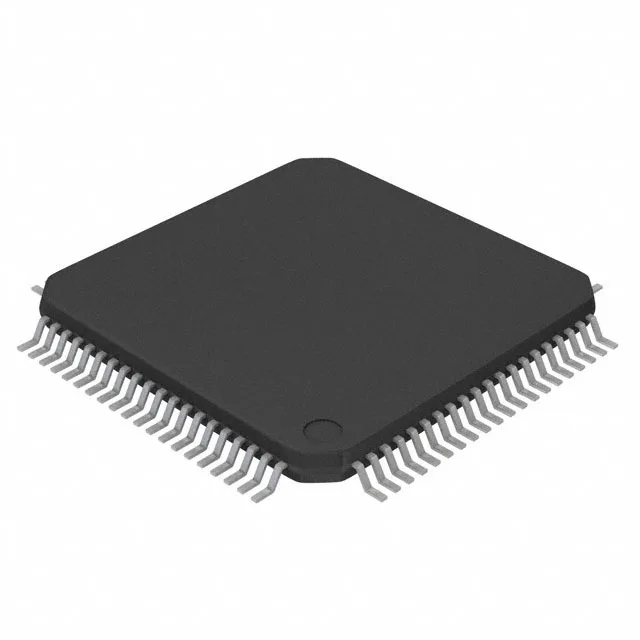
16-bit ultra-low-power MCU with integrated LCD drive
The 80-LQFP package (12x12 mm) brings out 48 general-purpose I/O lines, plus dedicated pins for the segment LCD interface. This is the part you pick when the BOM calls for a single-chip solution driving a segmented LCD — think utility meters, thermostats, blood-glucose monitors, or any panel that needs a local alphanumeric readout without the power budget of a graphics display.
32 KB Flash and 1K RAM — sizing the firmware envelope
The 32 KB Flash (32K x 8 plus 256 bytes) is the program store — enough for a modest application stack with the MSP430 instruction set, but tight if you are layering a full RTOS or a TCP/IP stack. The 1K x 8 RAM is the data scratchpad; watch the stack depth and buffer allocation during interrupt-heavy code. For comparison, the MSP430F43x family offers density steps up to 60 KB Flash, so if the firmware overflows 32 KB you step up the family, not change the footprint. The 8 MHz core speed is the CPU clock ceiling. The MSP430 CPU16 is a 16-bit RISC with a single-cycle multiplier, so 8 MHz translates to about 8 MIPS. That is plenty for slow-loop sensor readout and LCD refresh, but marginal for real-time audio or high-speed data logging.
The 8-channel 12-bit ADC handles analog inputs from thermistors, strain gauges, or current shunts without an external converter. SPI and UART/USART connectivity covers the common serial buses for external sensors, memory, or wireless modules. The LCD driver supports up to 4-mux or 8-mux segment displays — check the MSP430x4xx family reference manual for the exact segment count at your chosen mux ratio. This peripheral alone saves a display-driver IC and its associated PCB area, which is why this part shows up in handheld instruments and panel meters.
The base product number is MSP430F437, and the 'IPNR' suffix denotes the industrial temperature range, 80-LQFP package, and tape-and-reel shipping format. If your pick-and-place line feeds from reels, the IPNR is the correct ordering code. Both share the same silicon and package, so a tray-to-reel conversion is just logistics, not a qualification event.